
13
2025Masked cultures of Côte d’Ivoire
Cote d’Ivoire
Sacred masks and so much more
Another off-the-beaten-track trip. Arriving in the first village we were greeted by a whole load of kids all waving frantically and shouting something. As we asked our guide what they were saying, he smiled and replied: „white people, white people“. We are here to see the sights, but I believe we were the „sight of the day“ where ever we turned up. We did over 2000km in 2 weeks (on astonishingly good highways), and saw most of the lush and green country. We met wonderful people in remote authentic villages and learned about local crafts and crops. We witnessed ancient ritual dancing to the music of traditional instruments, where the whole town celebrated with the dancers and with us, and we saw acrobatics worthy of an Olympic diploma.
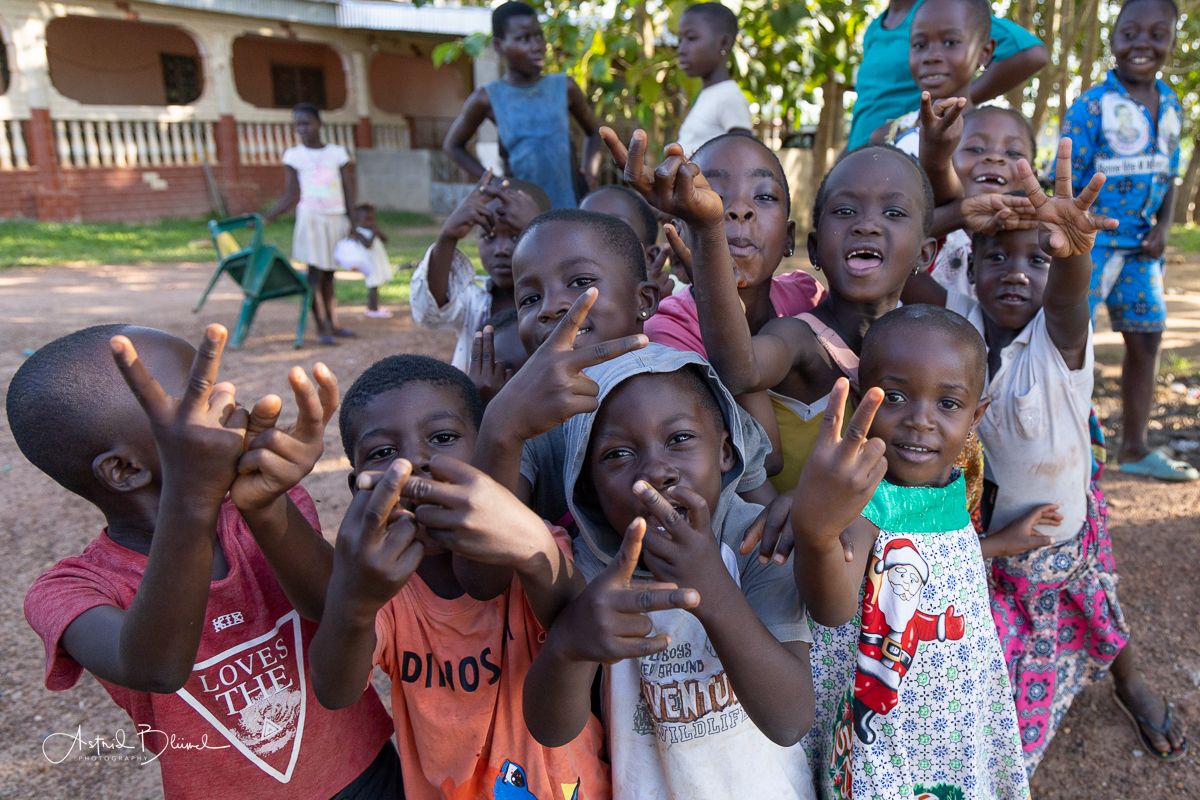
A welcome by the town kids
DAY 1: THE GOLI MASKS
We arrive in the capital Abidjan by Air France, which is easy, there are daily flights from Paris, not many tourists on the plane, I wonder who else is traveling there, beside us. After a night at a good airport hotel we start our adventure. We leave Abidjan for the town of Yamoussoukro, which is about 4 hours of driving on a massive 4-lane highway. The new president has started to build a superb road network throughout the country, the roads here are incredibly good. We check in to our 2* hotel and after waiting 2 hours for our lunch which we then gobble down, we leave for the town of Tiébissou. We are here to see a performance of the Goli masks.
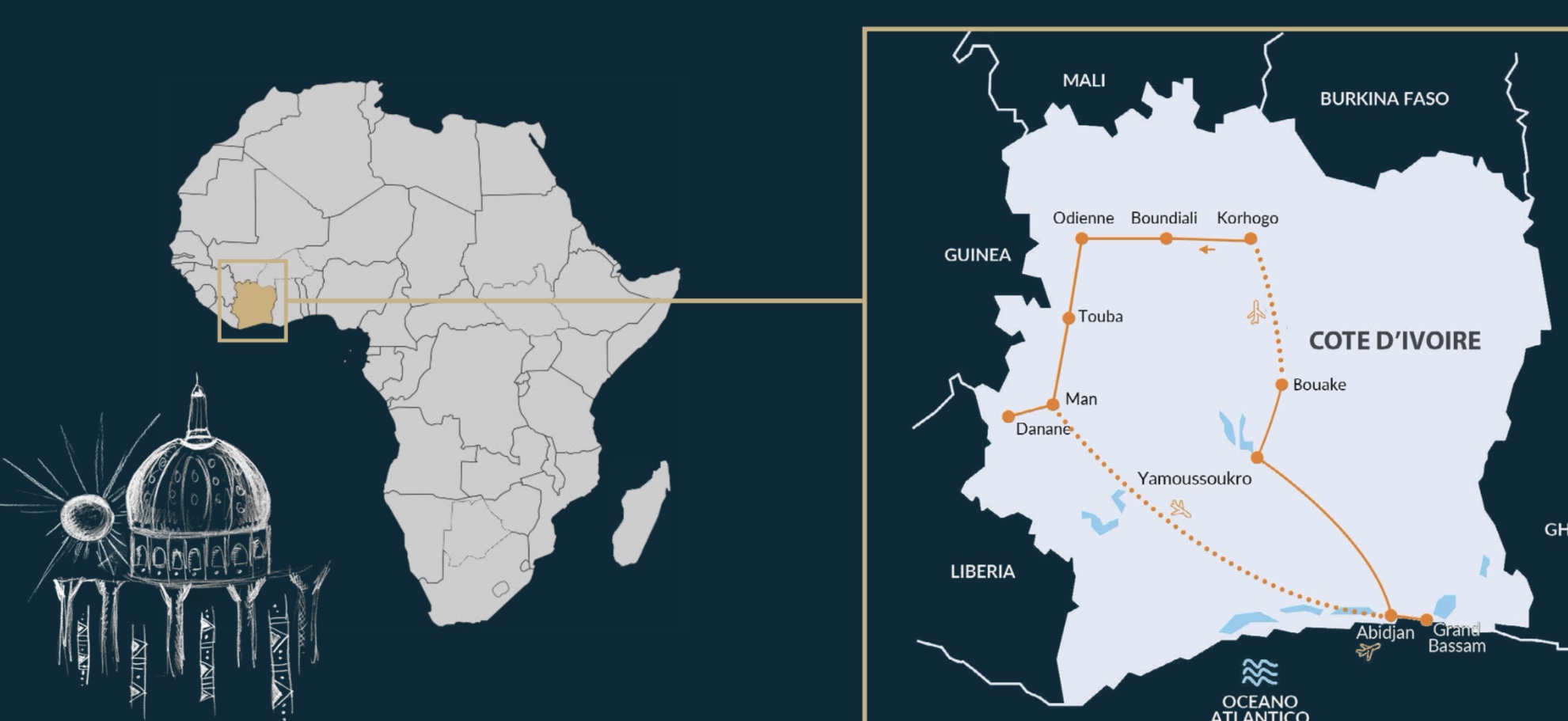
Map of Côte d’Ivoire
Once there we are greeted by the town kids which are exited to see us, but it seems we are also a little scary. The smallest kids run off and hide, peeking at us from a safe distance, or from behind mum or dad’s legs, and don’t you dare take a step closer to them, they will start screaming. We really are the exotic sighting of the day here ! We are led to a row of chairs, let the performance begin. The chairs are soon abandoned.
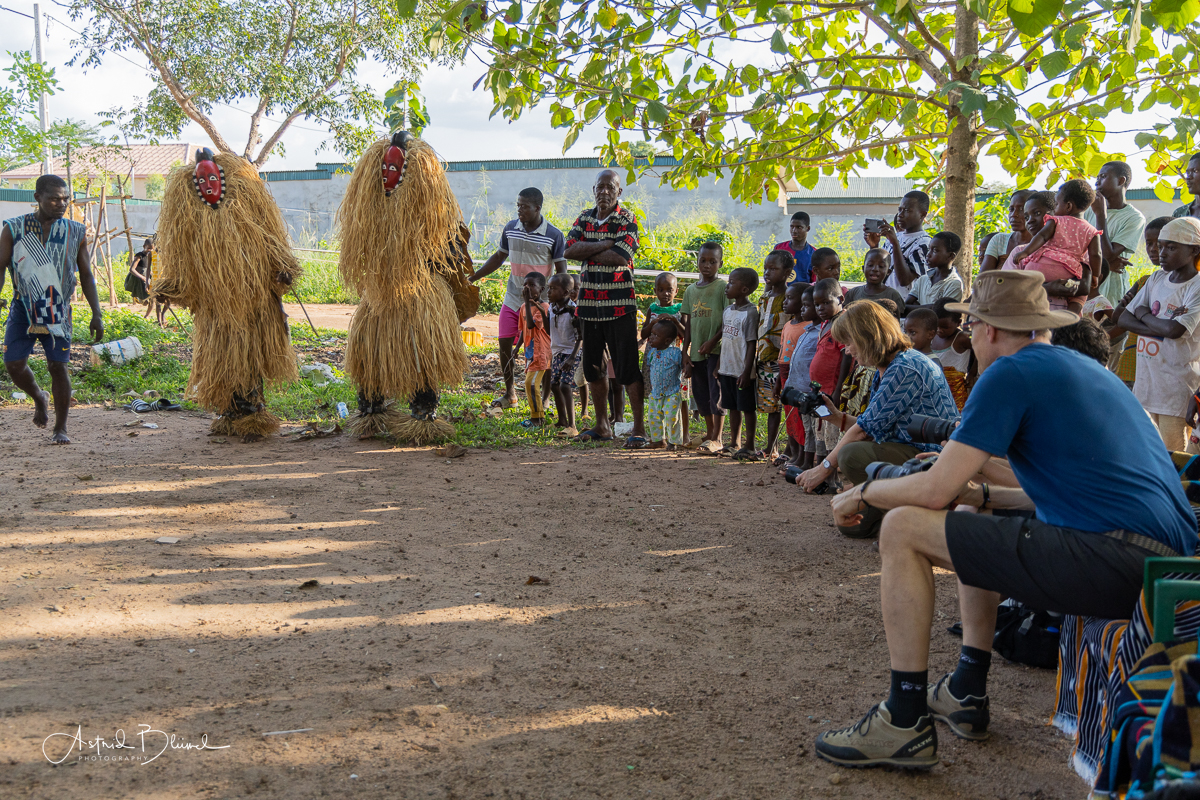
The Goli Gpan Pre masks
There are 7 Goli masks, which always perform in identical pairs, we see two of them. First the Goli Gpan Pre, the junior female mask then the Goli Glin, the senior male. They dance and jump and turn and the feet move at an incredible pace. I thought this was the one they call the worlds most impossible dance, but no, that’s for tomorrow and Kirsten says it will be even faster. All this is accompanied by music from some calabash like instrument and the loud shouting and clapping of hands by more and more kids and adults. It is such good fun.
DAY 2: THE BASILICA AND THE ZAOULI DANCE
Today we photograph the Basilica of Our Lady of Peace. Guinness World Records lists it as the worlds biggest church, even beats the Vatican. It’s pillars and floors are marble from Italy, the windows are stained glass from France, it can seat 18’000 people. From the outside it is overwhelming, huge and impressive. When we finally we get to go inside with a local guide, my jaw drops. I have never seen such a beautiful church. It’s marble pillars are 85m high and all around are stained glass windows with amazing colors, different motives and whole bible scenes, incredible. The pillars are immense, the ceiling is amazing and all the windows are just unbelievably beautiful. Unfortunately no photography allowed inside, so the iPhone will have to do.
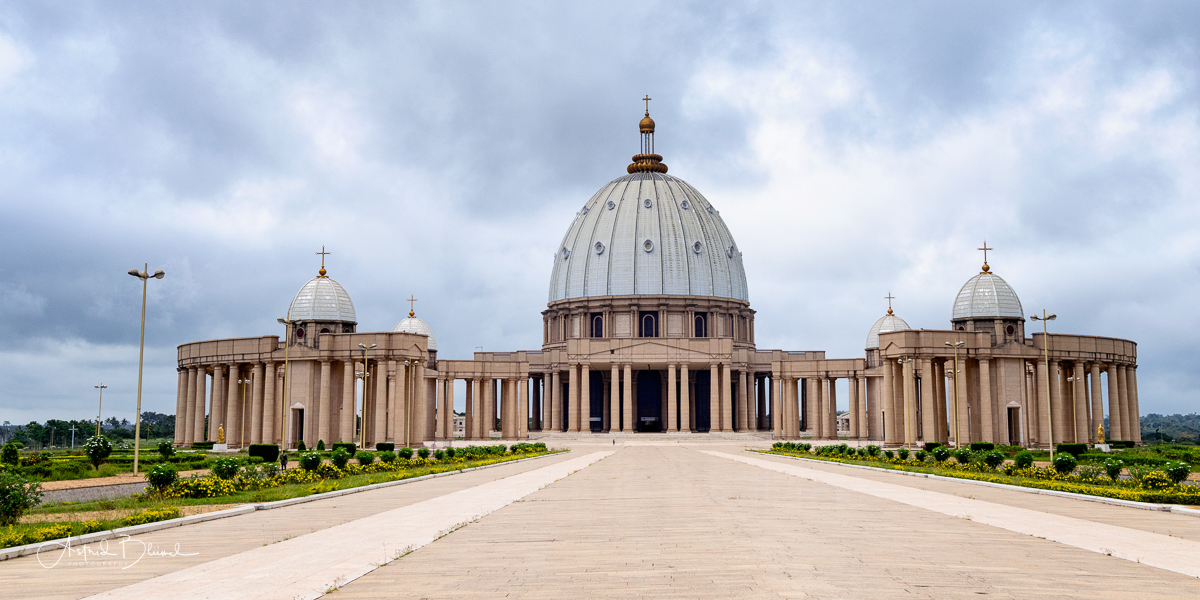
The most beautiful basilica there is. Can you see the person standing right in front ? Very tiny !
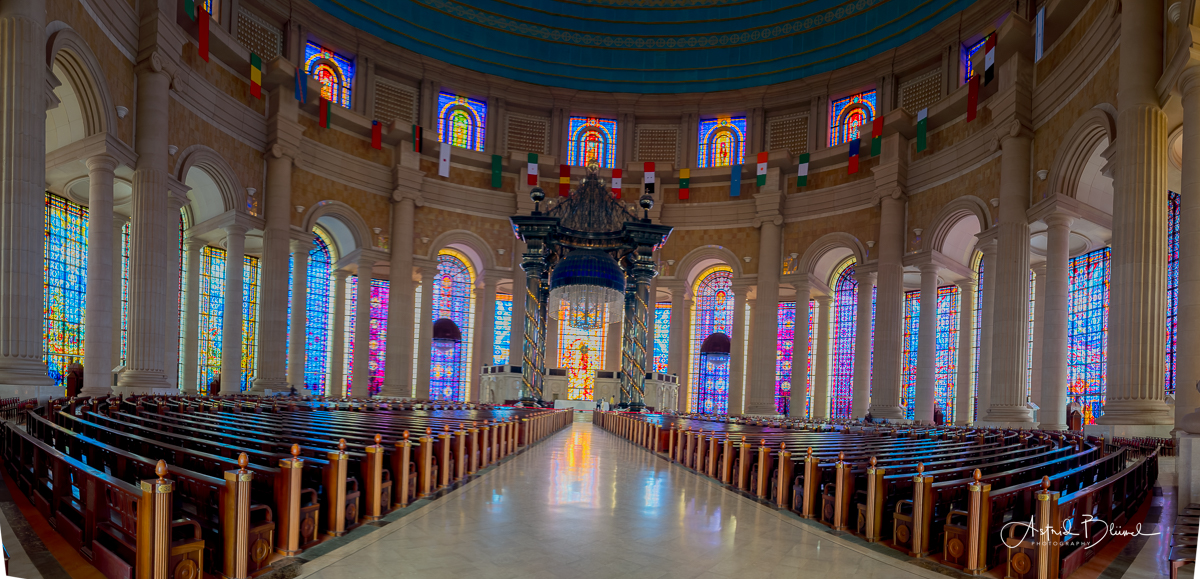
The inside is even more beautiful
Next highlight when arrive in Bouaflé and are led behind the first row of houses to an open space where our „chairs“, (this time it’s nice plastic orange ones), are waiting for us. Felix tells us, in Africa, when you have guests, first thing you do is get them a nice place to sit. So we sit for the first 3-4 minutes. The Zaouli dance is known as the worlds most impossible dance with incredibly fast footwork. As soon as the Zaouli dancer arrives the sitting is over, we sit on the floor, move around for a better angle. As always, half the town is attracted by the drums, and the crazy white people, and more and more spectators show up. These dance performances are for us, but also a way for people to celebrate and connect with their cultural heritage. This dance, through its intricate movements and rhythmic expressions, honors the beauty and elegance of women, portraying them as central figures in the Ivorian culture.
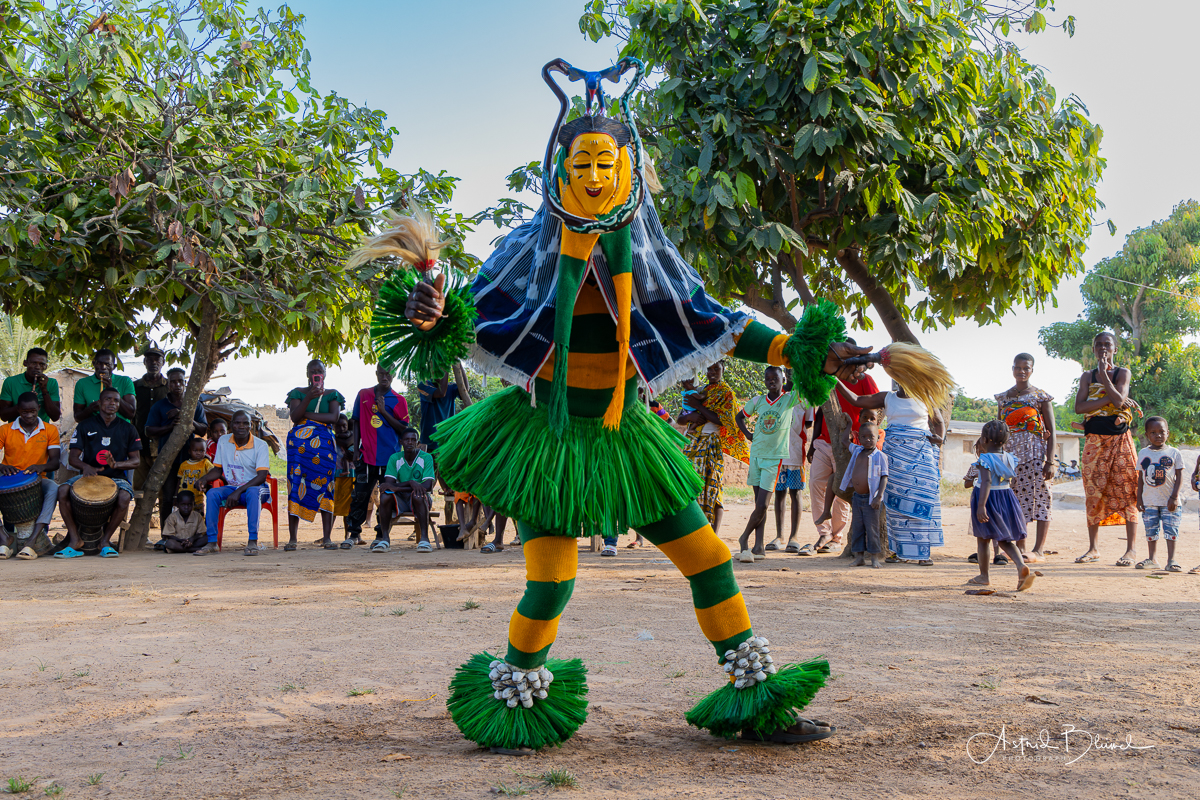
The Zaouli dancer, our favorite !
This guy is great, really puts up a show, poses, dances, jumps and everybody loves it. Compliments on the footwork Monseigneur. He leaves and returns with a different mask and dress, but not after getting me, then Chris, then Jürg to dance with him. The town thinks it is hilarious, we are on dozens of videos and photos, and they laugh their heads off. We don’t stand a chance against this guy.
DAY 3: LOCAL CRAFTS
First to Katiola where we visit a group of pottery ladies. This town is famous for pottery and we are shown how they first sieve the earth, then crush it with water to get the clay. Then grandma shows us how its done. The turning table she uses looks like the axis of a cars wheel, we are told it is one. Everything happens at a very slow pace, but really sweet and very concentrated, after 15min she says she is tired and stops. Was cool to watch anyway, we got some nice shots of her.
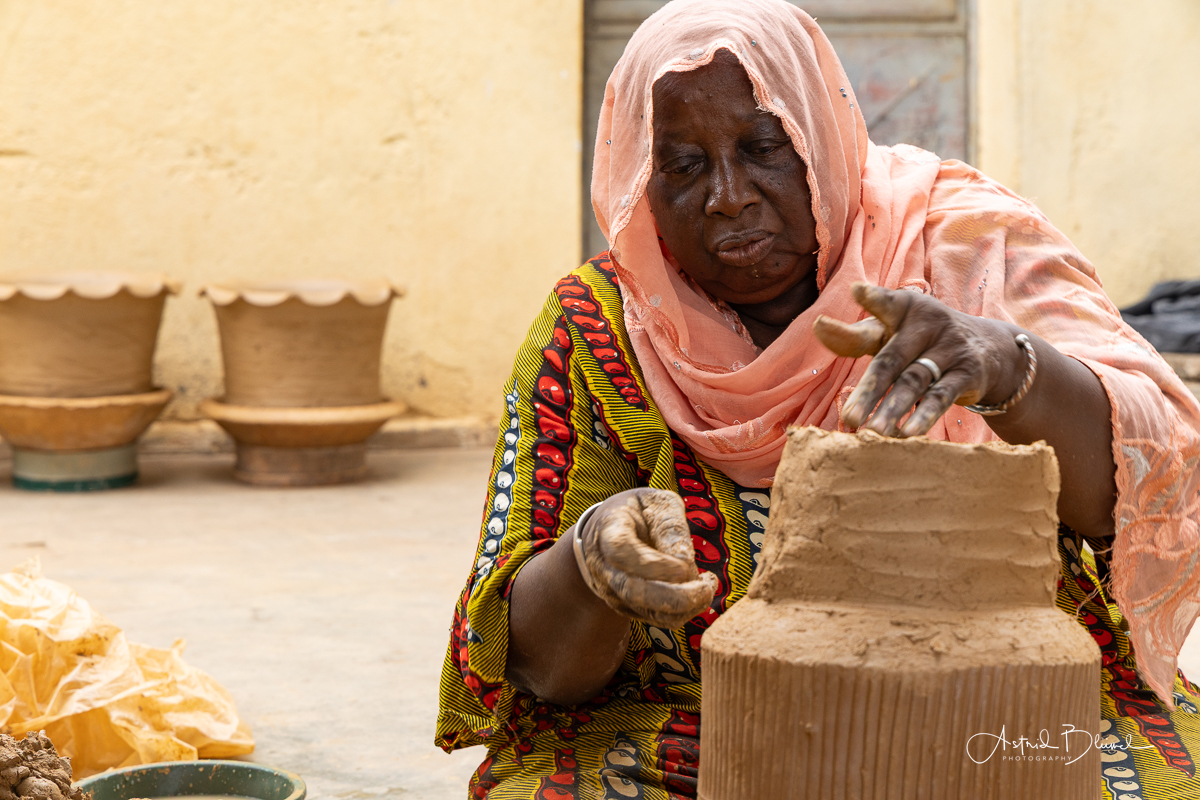
Grandma is almost done…
We reach Korhogo and we leave to see the xylophone maker. But first a stop at the beads shop. A man and his son show us how they make the beads out of clay, then paint them with paint made of natural materials, some plants and leave. The painting itself is quite special, they put the bead on a skewer, put that on their foot (whilst sitting on the floor) and turn the skewer whilst holding their hand still, no wobbly lines there. To paint they use a tiny feather which somehow looks like a guinea fowls. After that we’re led into the shop. There are so many necklaces, bracelets, earrings and other stuff, all very colorful. Do have to buy something, must support the locals !
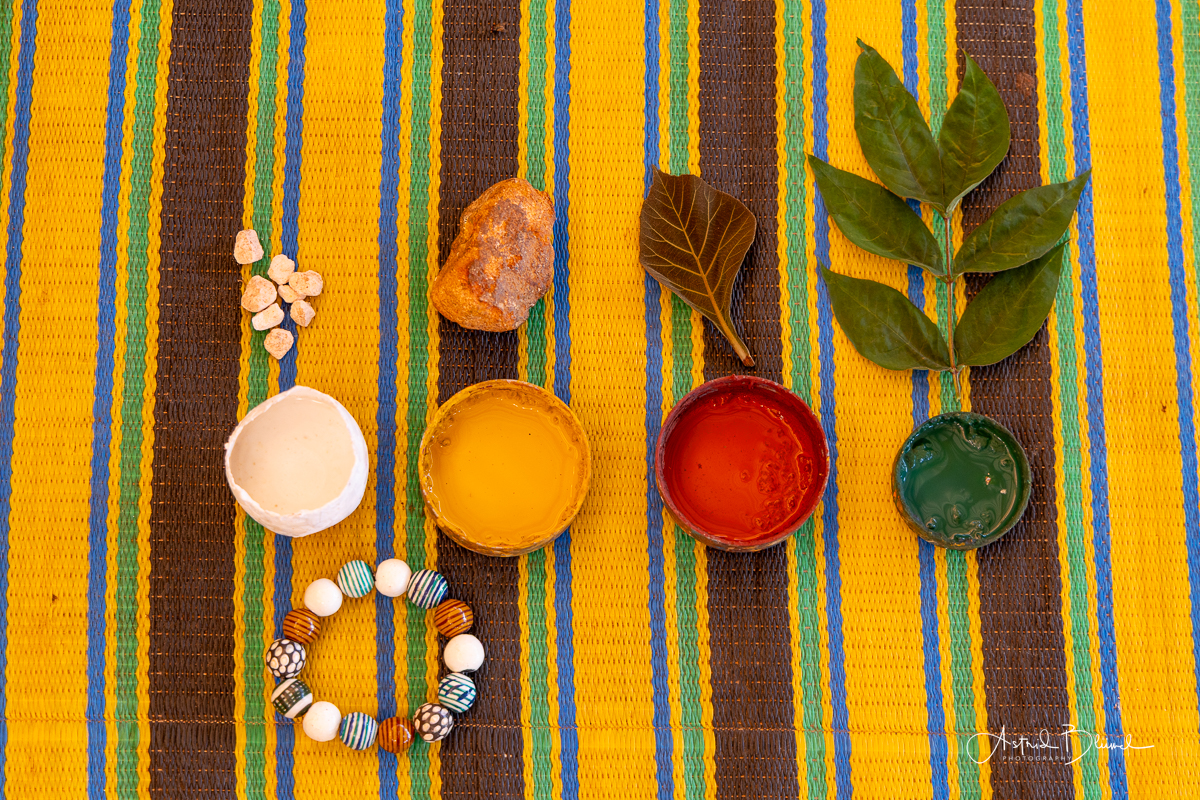
The paint, and the stuff they make the paint from
Then the xylophone village. We stroll through the village, take some candid shots. There is one old man which makes the instrument and we watch him for a while, then we have to go sit, what else. Incredible, there are four other white people, which makes it a total of 8 in 6 days, funny to see white faces here. There are two young men with drums and three with xylophones below which are calabash, to enhance the noise. The women of the town join in and dance to the music. We then do a private shoot with the xylophone maker and two of the musicians.
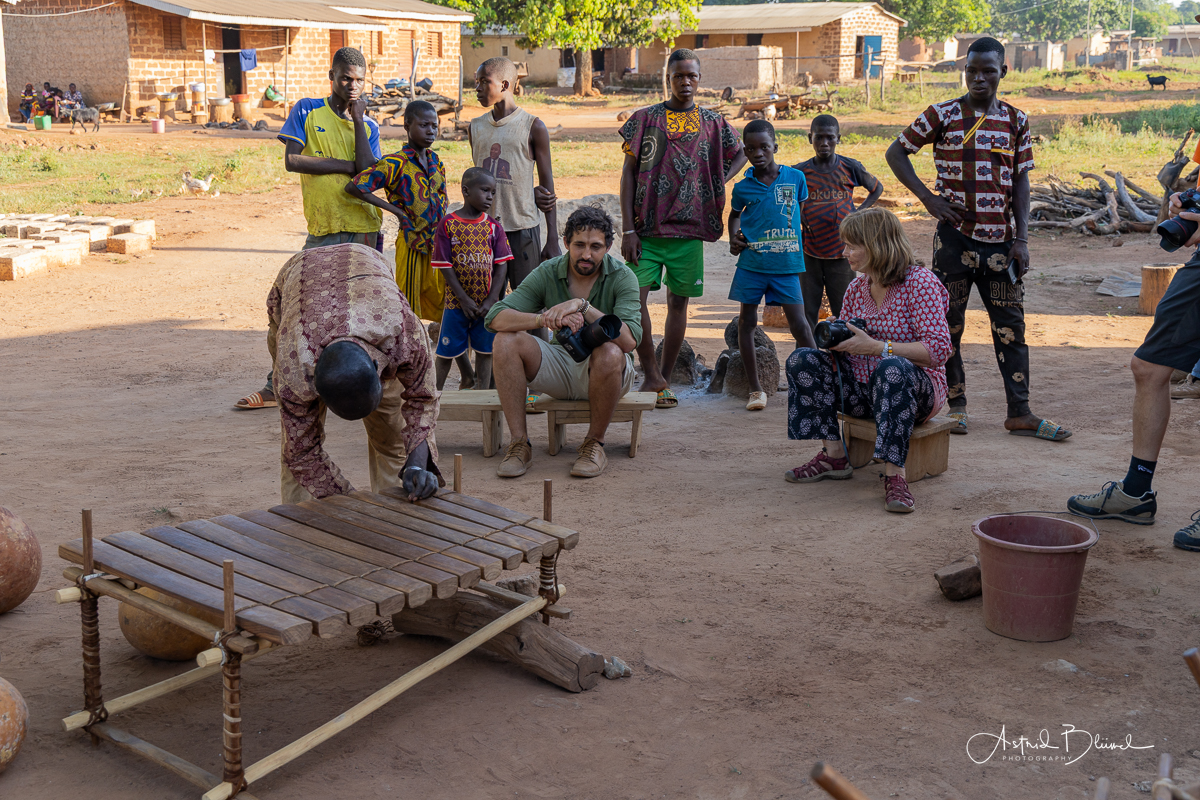
Watching the xylophone maker at work
DAY 4: FULANI, SHEA BUTTER AND THE BOLOYE DANCE
We arrive at the Fulani village and get to walk about, try to get some nice shots. Kirsten shows them a photo of Fulani people he took the year before, and one lady agrees to dress up with nice clothes and jewelry and all. This will take some time. So we do anybody else who is willing to pose until she is ready. In the end I believe we had most women and kids on the picture. Then the „fancy lady“ is ready, she really looks good. The absolute hit is Kirsten’s little printer, we print out 2 or 3 photos and give it to the people which gave their best, they absolutely love it.
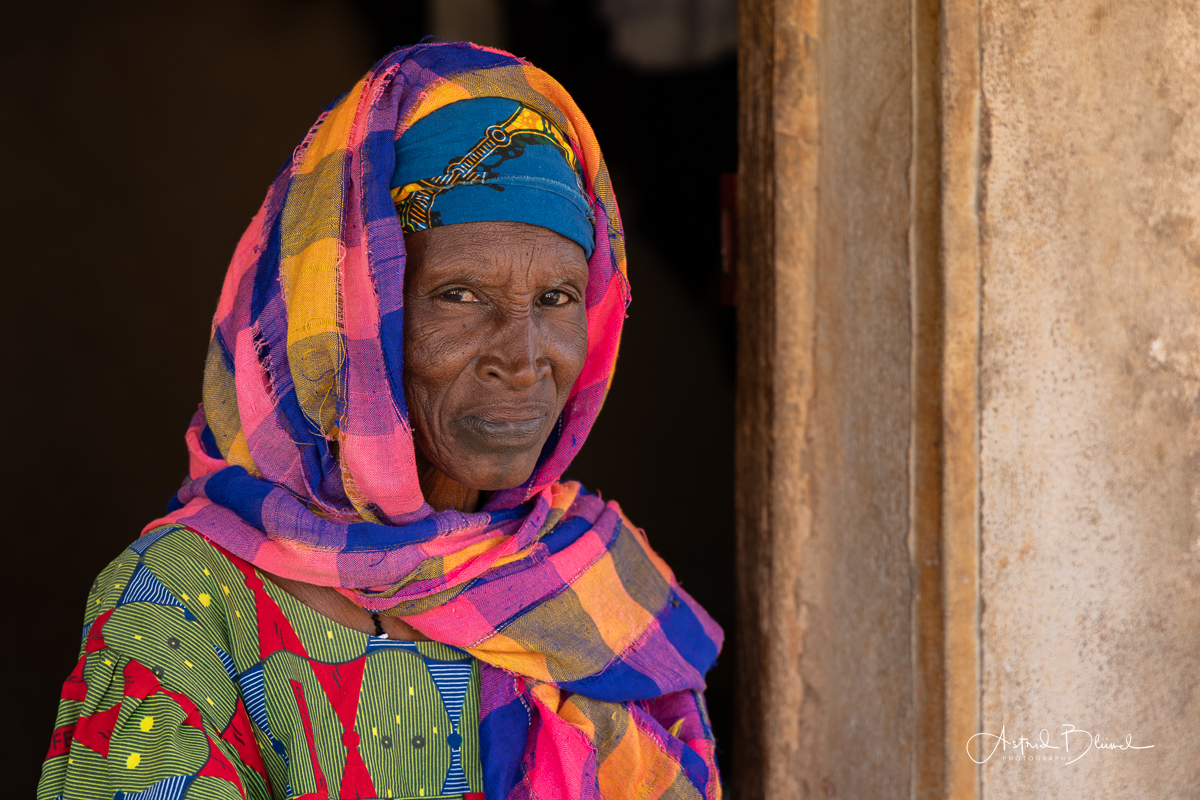
A Fulani grandma
On the way home we stop at a blacksmith, which is a nice little outing, then on to the woodcarvers in Korhogo. Turns out there is a whole street of them. Come to my shop madam… here we go again, I try to resist but I just have to buy one of the hornbills. Well actually I buy two since one is 40’000 and two are 35’000, so 70’000 for both? No, 35’000 for both, I don’t know how they calculate here, but might as well take both then.
In the afternoon it is time to see how shea butter is made. Which honestly isn’t an easy job. They grind, roast, the ovens are absolutely glowing hot, and it is over 30°C and very humid as it is. The bowls they carry away are huge. Now water is added and with stirring it becomes a thick, heavy, brown mass, the work looks extremely arduous. The brown mass is then boiled to separate the butter, they have to keep skimming the oil off the top. The leftover is dried and later used to heat the ovens. Now that is recycling ! We get some nice shots of the whole process and in the end all buy a little pot of the finished product, the white shea butter.
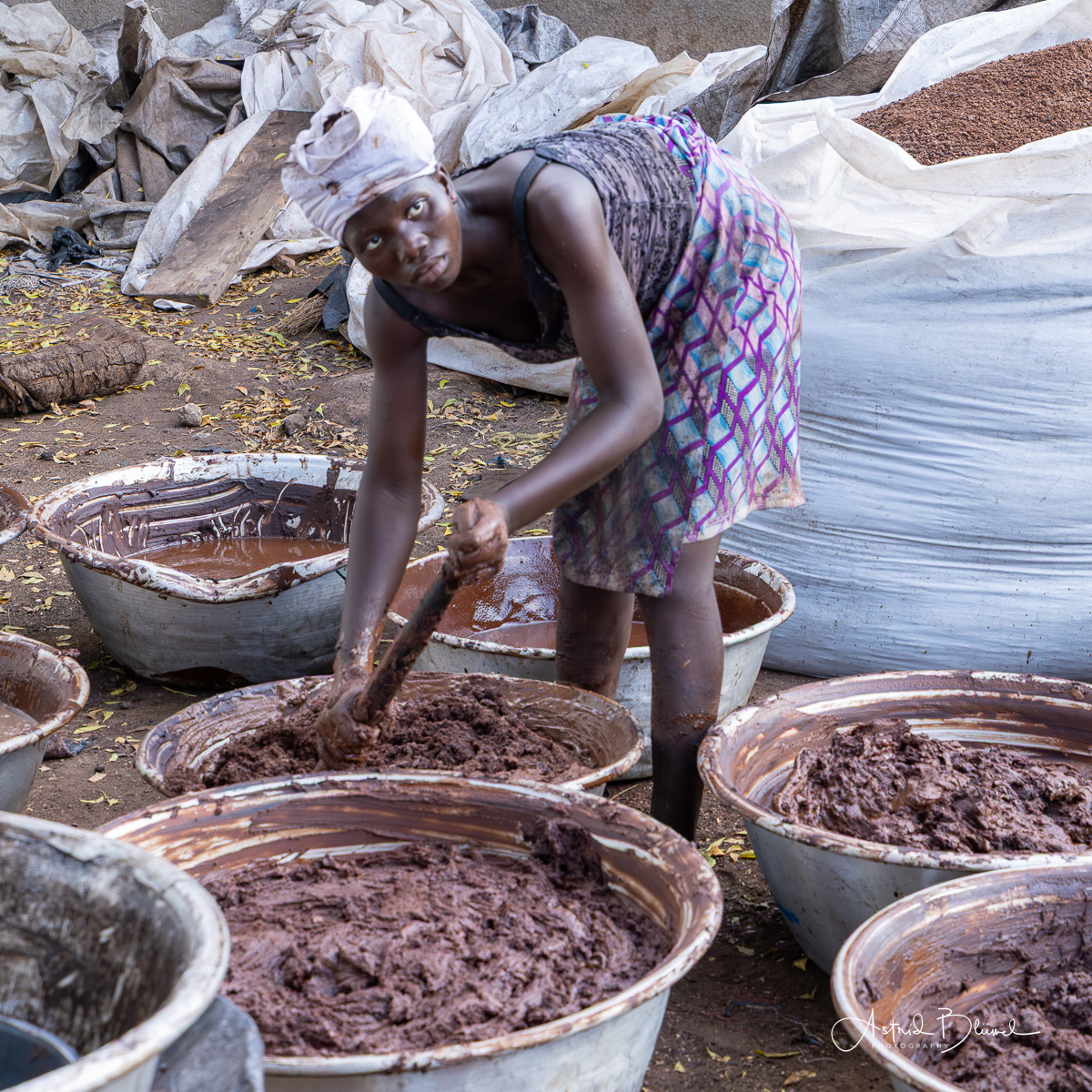
Making shea butter
Then the highlight, the Boloye or panther dance in a village a mere 10km from our hotel. We are again greeted by loud cheers from all the assembled kids, at this town they all wanted to shake hands with us, so we shake a few dozen little hands before we can move on. You’ve guessed it, to our chairs.
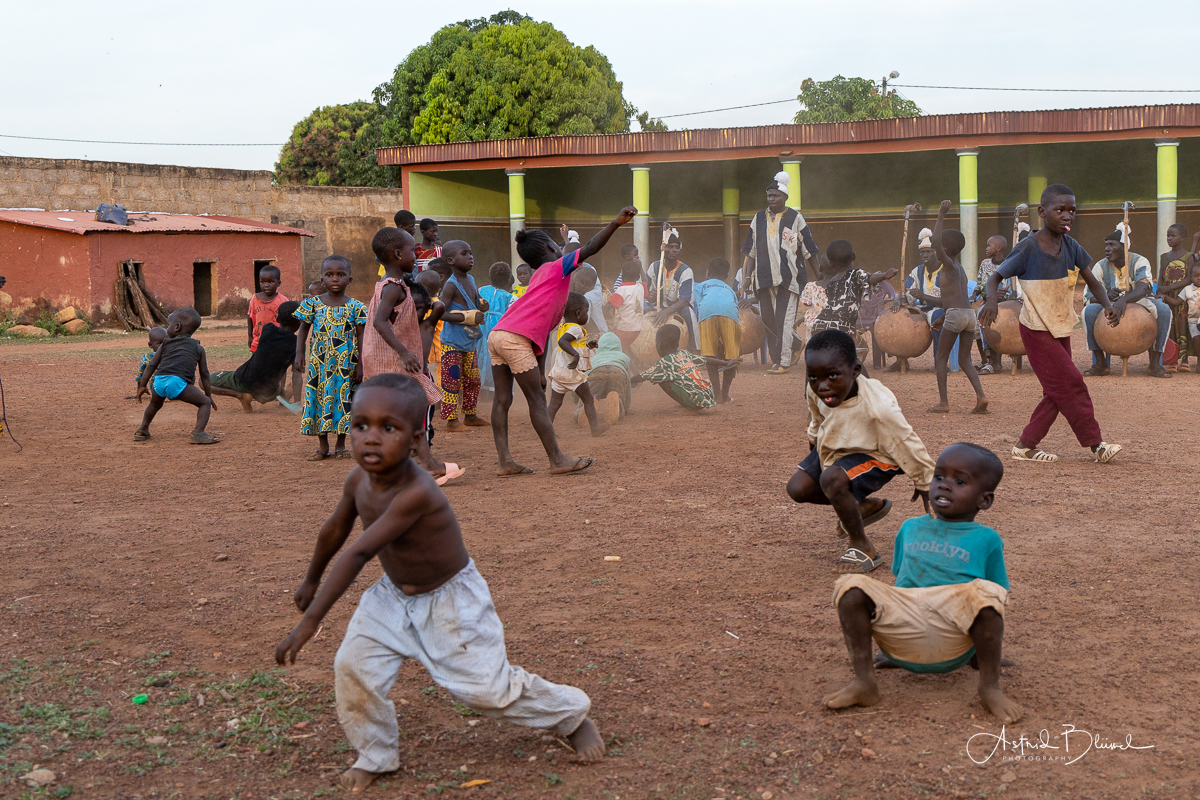
The town kids dance until the show starts
Five young men dressed in the panther suits are to perform, but that takes a while, so we sit for 40min watching all the towns kids dance and jump to the rhythm of the music. I believe that was the longest „sitting session“ of the whole tour. When the „panthers“ finally show up they most of the kids run away, they have great respect for all things from the sacred forest. Those still around are told to move back so we, the white photo people, can get the best view from our chairs. As usual the chairs are soon abandoned and we sit in the dirt.
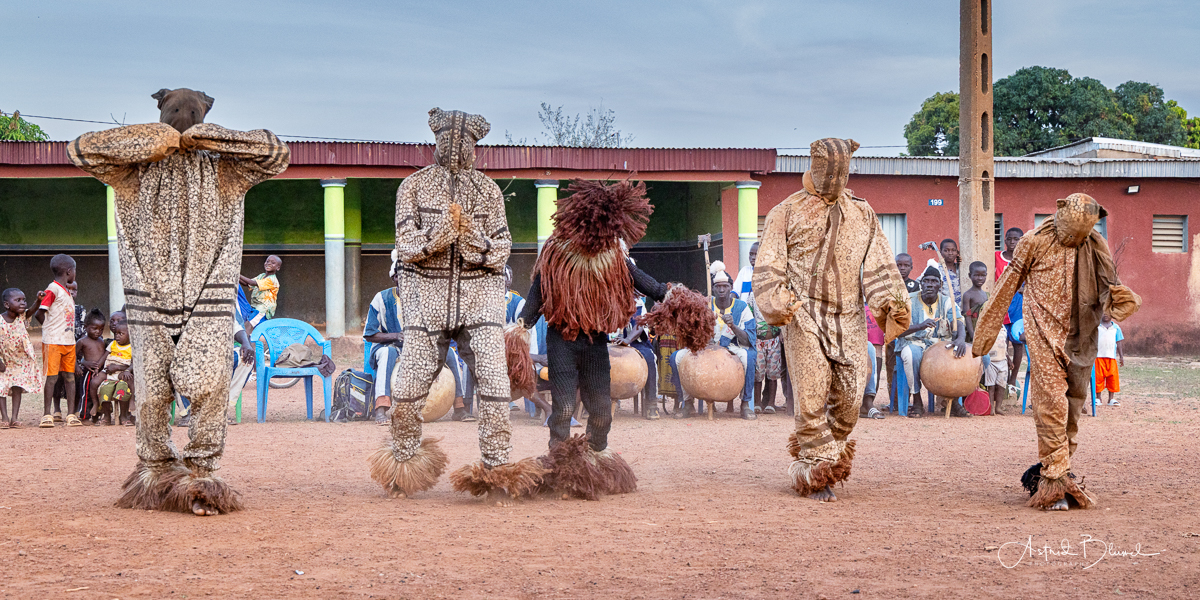
Here come the panthers
Up here in the north the Senufo social order is strongly influenced by Poro, a male secret society. The initiation last 21 years, (3×7), and most ceremonies are strictly private. This dance, the Boloye can be performed for a wider audience, in our case the four of us and the rest of the town. The performers aged between 8 and 15 hold thin sticks or twigs in their hands whilst jumping and dancing doing somersaults and flips like olympic champions, incredible! If they break or lose the twigs they are punished by being demoted in their initiation journey. But no worries, they are all superbly in control. The five of them take turns and one is cooler than the other. The smallest one which is dresses in black, is really cute and even does splits, wow. With some trouble we get them to pose after the show, standing still for a change, in front of some bushes, to sort of make it look like wild panthers in the forest. The holy forest truly is a big thing here, most dances originate from it.
DAY 5: PICASSO, A FETISH HUT AND THE N’GORON DANCE
We leave early and drive a nice road to the village of the painters. The rumor has it Picasso himself visited here. His paintings have distinct African elements in it, they say that is the ultimate proof he was here. This village is like 20km from any main road, so he must have gone on a really long walk to find it, but the story sells. One guy is painting and shows us how its done, he uses a toothbrush and a knife to paint ! First brown then yellow over that, which turns the whole thing black. There are about 6 or 7 huts and in each are paintings of an artist, I am tempted but Jürg reminds me we don’t have any empty walls left, so let’s be good. I scare another little boy as I do one step towards him, he runs off to hide behind daddies legs and starts screaming. Boy I must be a scary sight, so big and white.
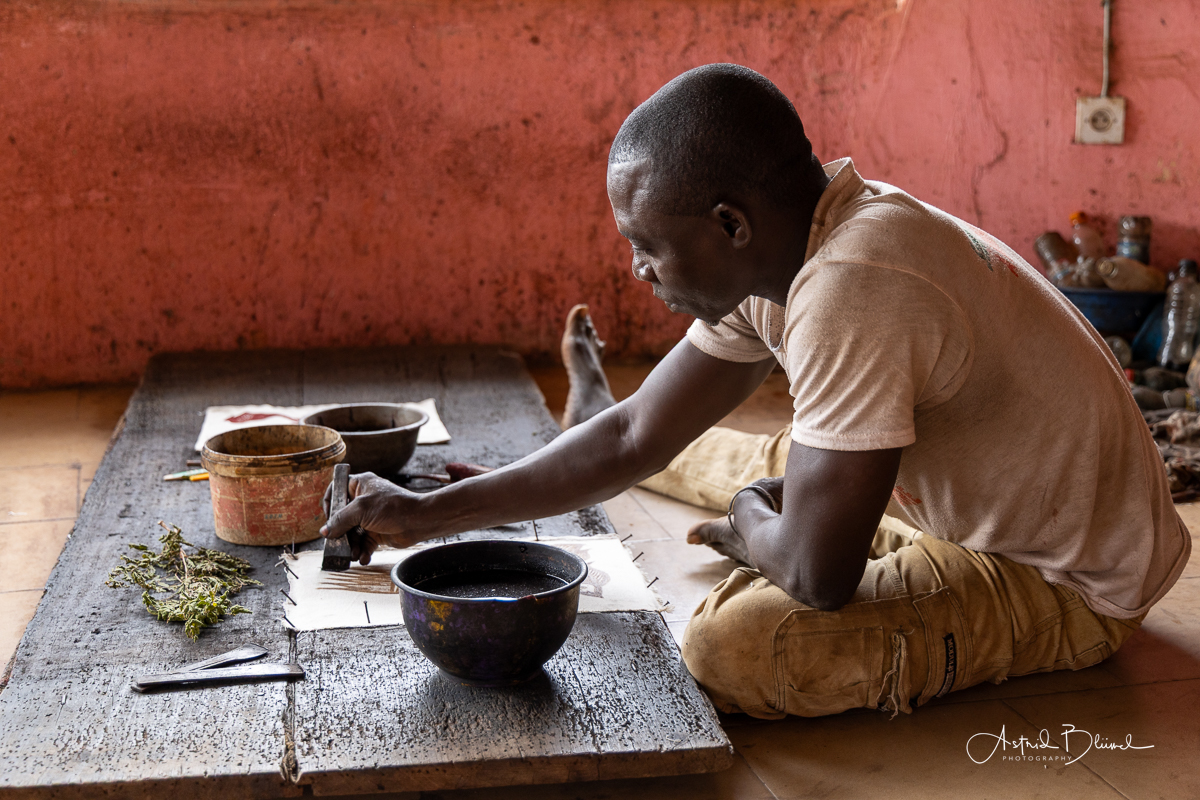
Picasso’s painting village
From there to the Big Fetish big Hut. The road is horrible, lots of roadworks, where the new road is, it is sublime, but in between it’s dodging potholes most of the time. We get to Niofoin by noon and it is boiling hot, the huts are closed, fetish shows only when you bring some sort of offering like a goat or chicken, (which we don’t happen to carry), and only on Monday, Friday and Sunday. So we take a few shots in the harsh light then flee to the air-conditioned car. Another hour gets us to the village of Boundiali. Our afternoon program, we leave for the village of Kounoumon for the N’goron dance. The kids here are rather timid and stay at a safe distance, at least they don’t start screaming and crying when I get closer. There are two benches set up, so we do the obligate sitting part for a few minutes. It is lovely in the shade of a big tree, a breeze is blowing, it is really nice!
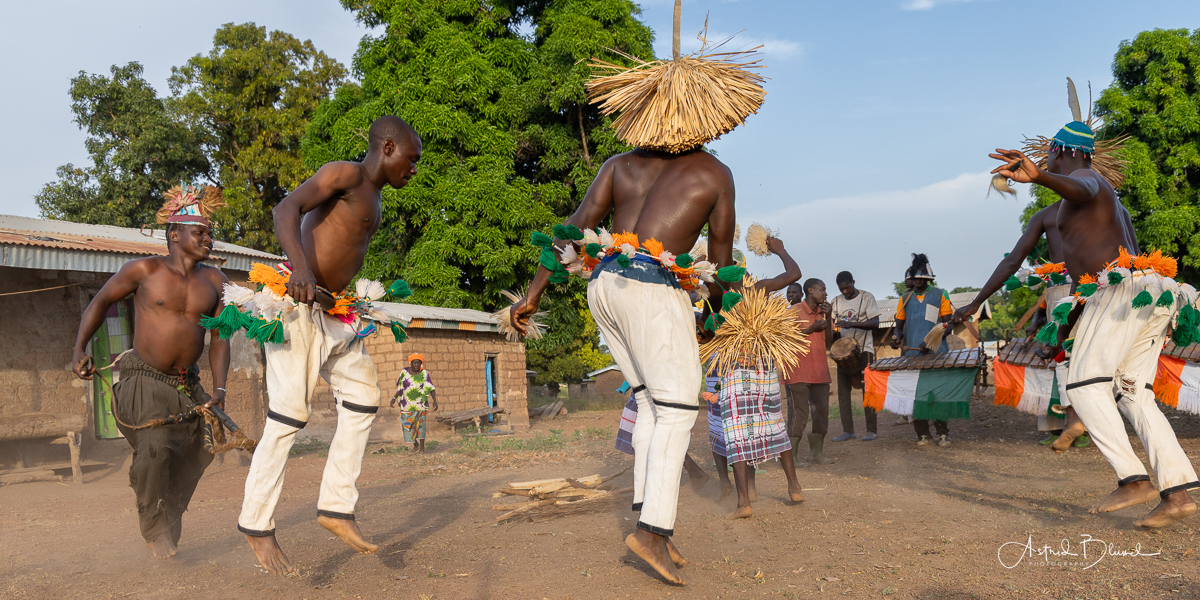
The N’Goron dance
There are musicians with xylophones, a drum and some sort of flute. Three bare breasted girls and three men in white, with Chinese-like triangular and pointed straw hats, dance around the fire to the music. The 4th guy is different and has an enormous whip, when he lashes it, the music and dance change. Boy it is loud when he cracks the whip. They dance around the fire and at some point the whip guy takes burning wood from the fire and streaks it over his skin, then he literally sits in the fire and rolls around in it. Crazy people here! But this show was cool to watch ! After that we had a posing session with the girls, the whip guy and one of the men who had a most sympathetic smile, also really great.
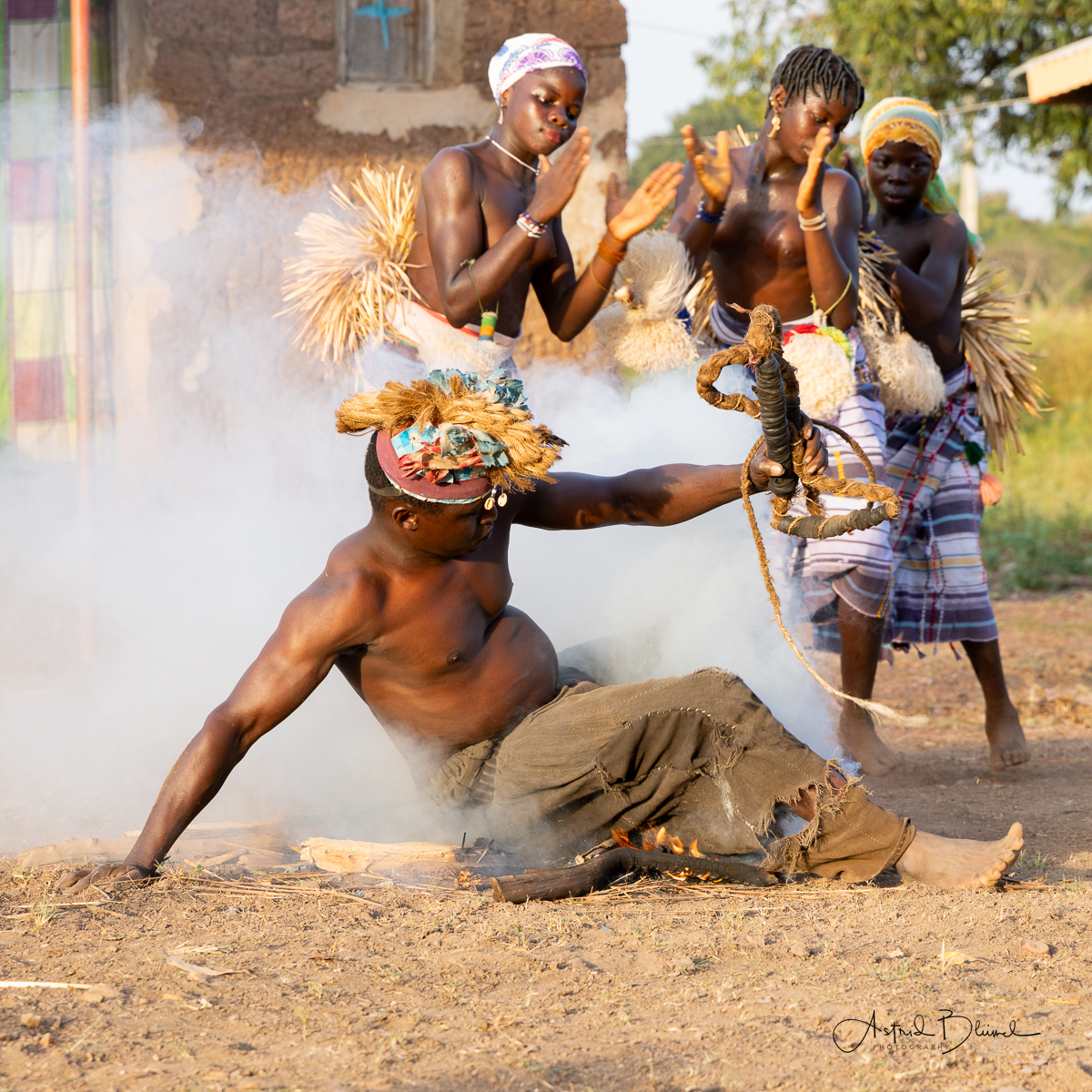
Another possible interpretation of “hot pants”
DAY 6: MORE FULANI AND THE DOZO HUNTERS
Another Fulani village 30min from our hotel. We leave the town, drive a narrow road, rather a track, which gets narrower and narrower until we reach the village. Our driver Mr. Laz is complaining we are ruining his car. It is quite a big place, there are groups of huts all over, each is a family. In between pastures and fields and lots of plastic junk of course, though it is not as bad here as in most other places. Kids come to greet us and soon after we greet the village chief and the first photoshoot gets on the way. The young girls are very pretty, the little boys cute and they all are willing to pose after they see the first photo. They love looking at the little screen and recognizing themselves.
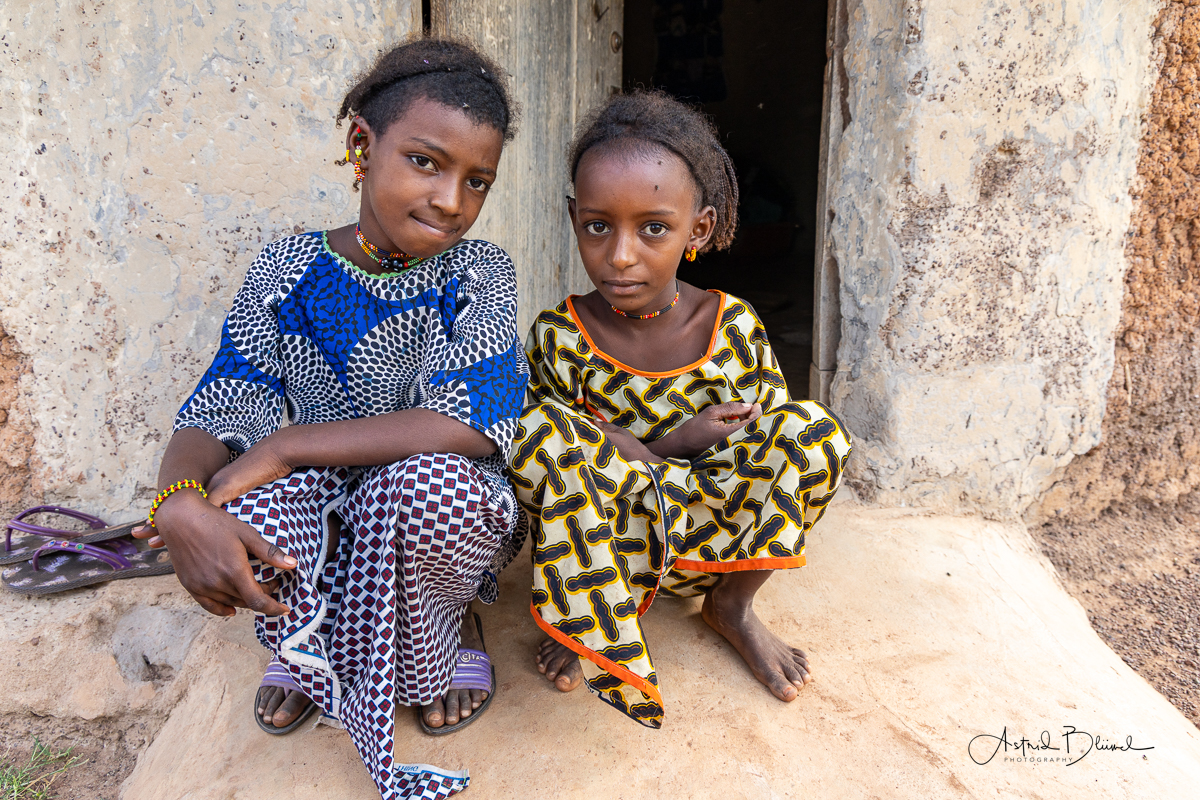
Two of many Fulani girls
Breakfast back at the hotel, then we move on to the next town, Odienné. We are in the top north-west of the country now and will soon start heading back to the coast. When we sit down for lunch it starts to rain, no to honest, it is more like the heavens open, it is a downpour like I’ve rarely seen. The rain drums on the corrugated tin roof and the sound is deafening, we have to shout if we want to speak to each other, visibility is down to zero and small rivers start to flow on the parking lot. An hour later it is all over, a lot cooler and very wet everywhere. But it is dry and there is light so lets go.
The Dozo hunters, a society of men, meet in the sacred forest. They are spiritual guardians, with deep cultural and historical significance, but also healers and skilled hunters and in charge of the regions security. They follow a strict moral code and perform rituals that honor the natural world. Also they seem to be a bit of a biker gang, as they follow us to the forest on their motorcycles. They dance for a while, then we climb the hill to the rocks on the top where we do a cool photoshoot, then more down in the forest. The funniest part is when we leave, and get them on their motorcycles, all smiling and waving.
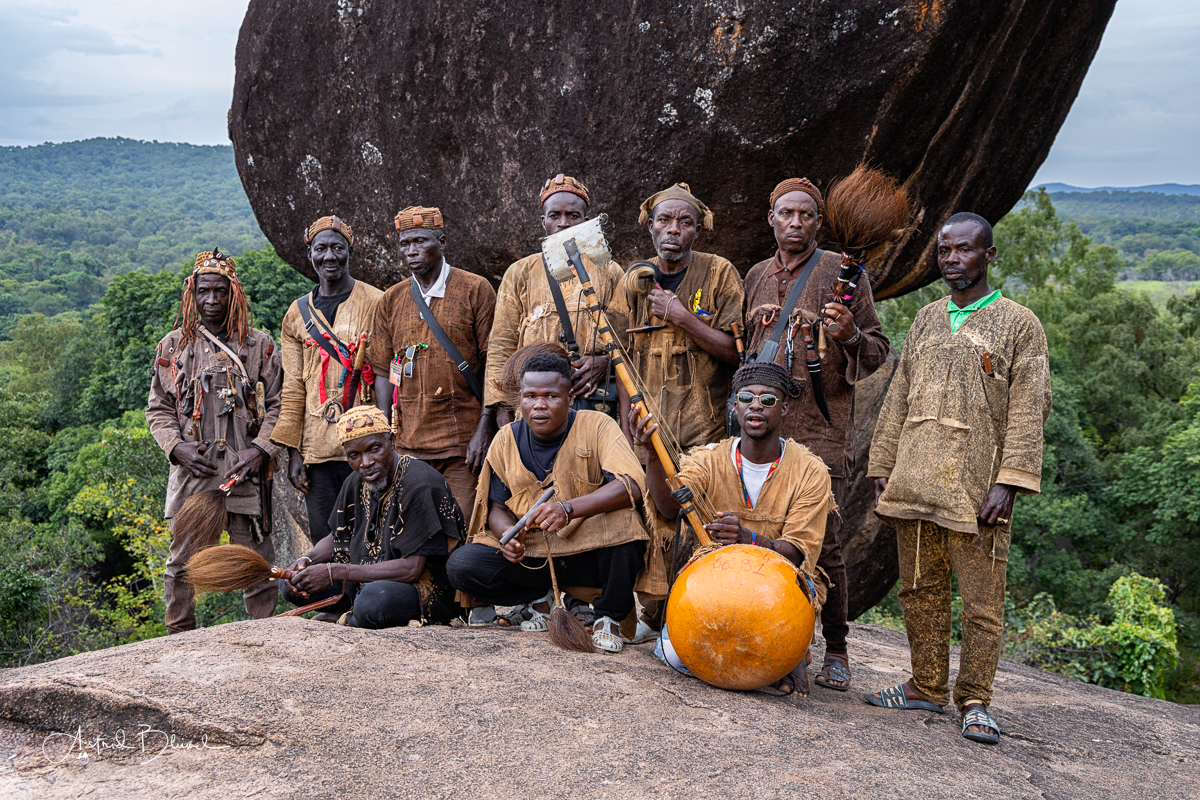
The Dozo hunters
Dinner at the hotel, rice, chicken (bone with little meat) and guinea fowl (more meat), and really nice spicy sauces. Sauce here is called soupe, or the one special one is grain, which is some palm oil sauce, very tasty. Meals are usually served with attika, a maize couscous, or atoke which is fried plantain, also very yummy and there is always some fresh chillies on the plate, so spice up your life.
DAY 7: TOUBA TOWN AND THE GIBLE DANCE
After our staple breakfast of omelette, French baguette and Nescafe we drive for about 2 hrs to reach the town of Touba. It is like driving in a green tunnel, mango and cashew trees, (sorry wrong season, no chance of buying some), cacao trees, rubber- and banana plantations, cassava, maize and other green stuff. There are bus stops where vendors sell their produce to the travelers, and colorful mini busses, on their rear usually a painting and some God- or mother-loving text: mama I love you, God have merci, with God everything is possible, God help me. I don’t know if I would want to ride in that particular bus ! Rather take one with a painting of a soccer champ.
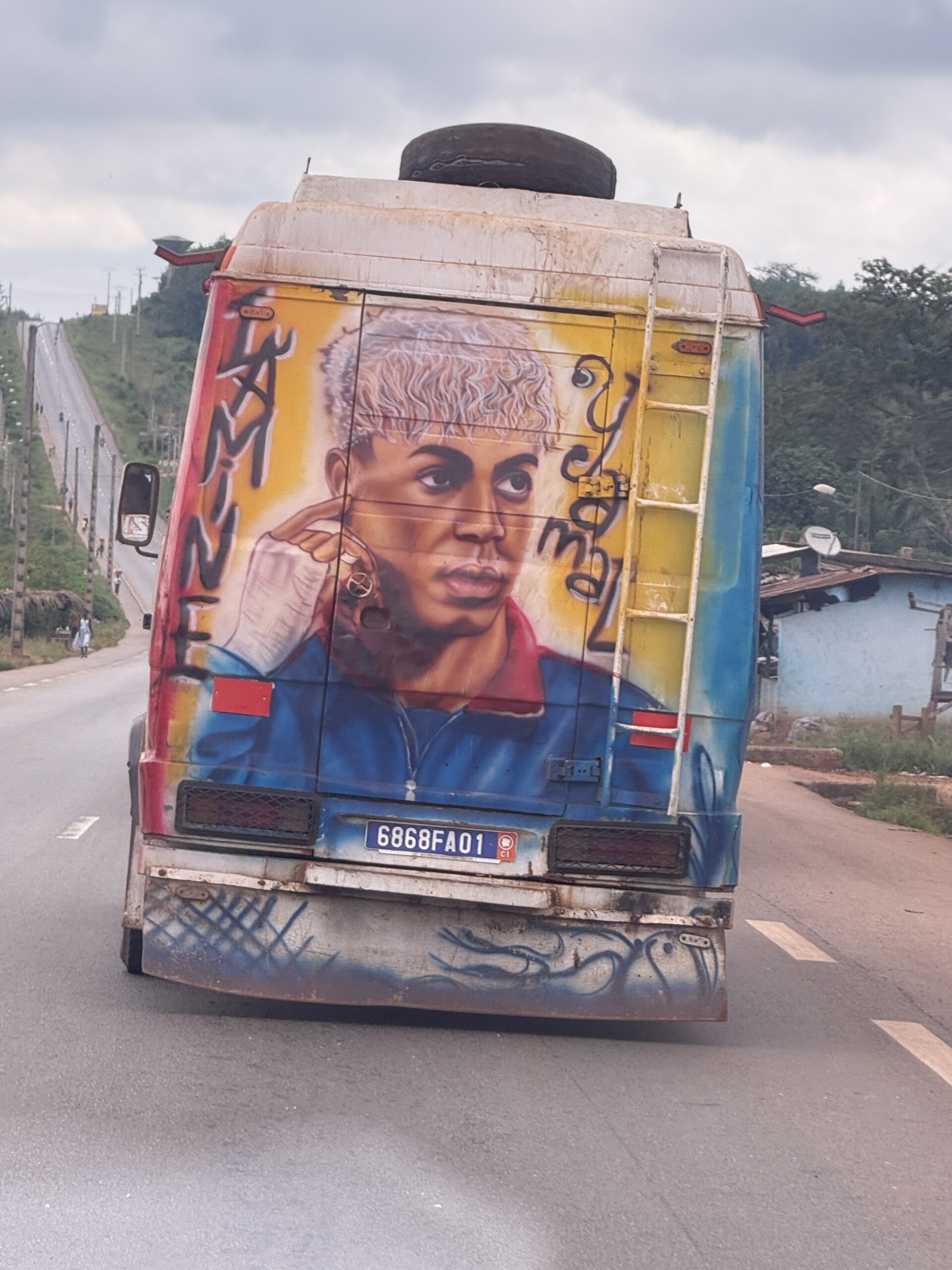
Which bus to take…
Waiting at the petrol station because we are a bit early, Chris and I wander off for some street photography, it is good fun and most people wave and call us to come and photograph them, a few others we ask permission. From there off into the bush to another remote village called Silakoro, where we will see the Gible dance. As usual we are greeted by the town kids and led to our chairs, nicely in the shade of a tin roof. A whole group of elders is already assembled there, all in blue and white robes, we of course get the first row beside a couple of the elderly gentlemen.
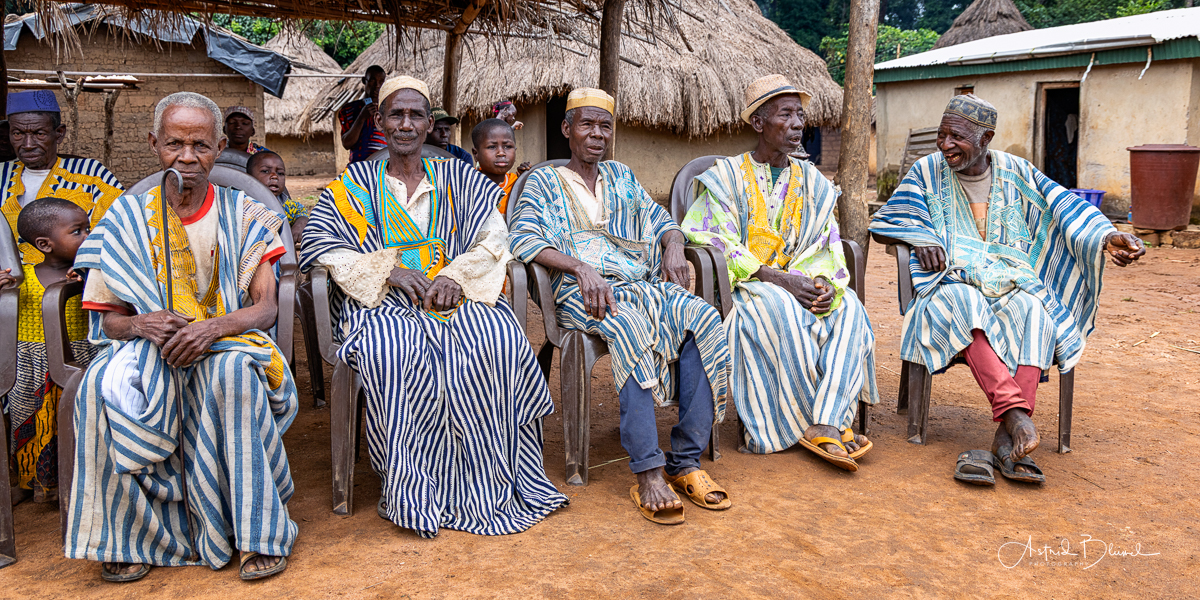
The village elders
Before the show starts we are led to the sacred river to see the sacred fish. The elder throws in bread and the fish are there in no time. We are in second or third row here, all the town kids are right at the waterside enjoying the show. There is a huge fallen tree which lies across the river and the bravest few kids climb on it, shouting photo, photo. We oblige. Then back to our seats.
First the music, to which all the town kids hop around, they can’t sit still (which is normal for kids). All the kids are camera addicted (which is also the new normal here). As soon as you point your camera at one of them, 10 others rush in, to also put their face in the picture, so funny. The men dance and by now all the ladies of the town have arrived, all are singing and clapping their hands. An exiting Saturday afternoon outing, there must be 200 people here, and at least 100 kids. And all of that because of 4 photographers and their cameras. Well it is a show for the whole community and they will have something to talk about for a long time. The highlight is the guy on stilts, which moves about, does turns on one leg and swings the other at 90° to his body, better duck if you are close. There are 4 guys around him to support him if he falls, which is definitely necessary.
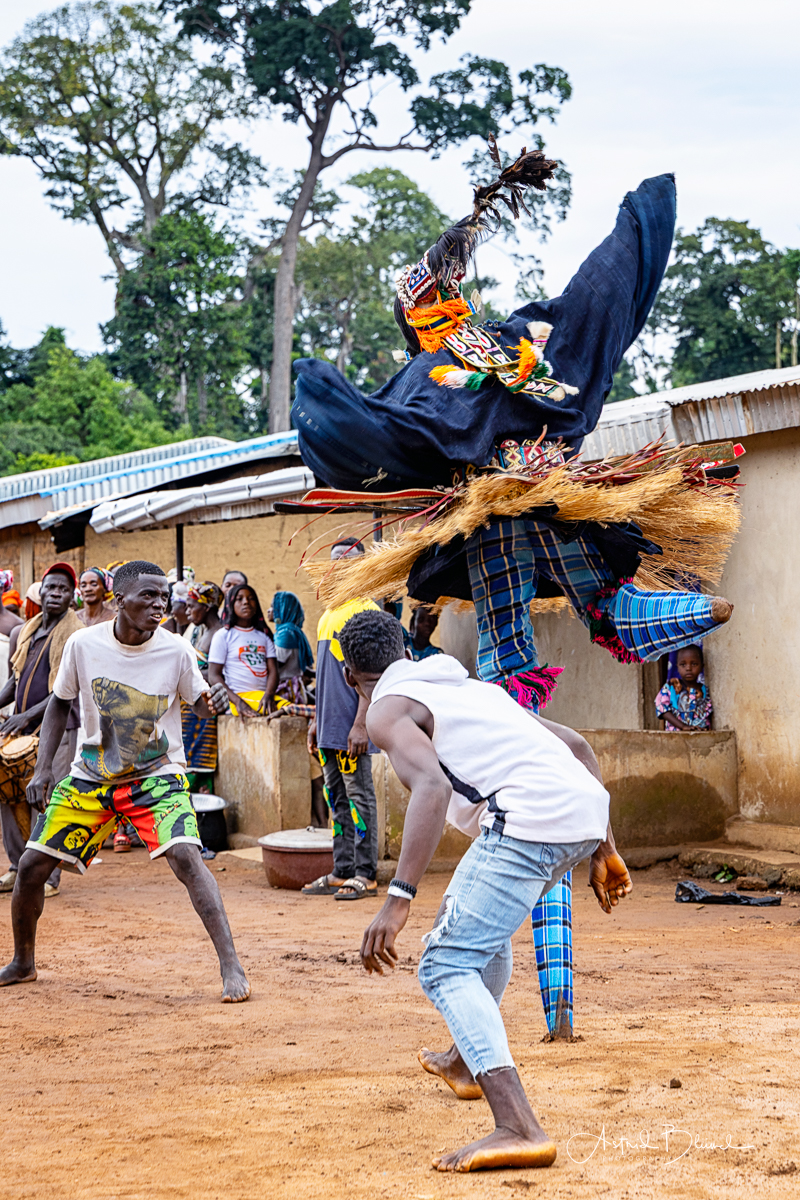
The Gible dance performance
Then all the town kids start running around with green branches in their hands, going up one street, coming back around the next corner, like a moving forest. Now the forest spirit comes. This is a lovely costume with a straw skirt and an amazing black mask, he dances but as soon he gets too close the kids they dash off. We get permission to photograph the spirit at the river.
DAY 8: DANSE DE JONGLEUR
This is the shoot I was most looking forward to. We drive for about 2 hrs to get to the town of Bosobiaglu. First the main road then a bad dirt road. At one point we have to cross a little stream over sort of a bridge…assembled branches, sticks, and planks, we all get out which is good, now we get to do a nice video of the crossing. The road gets even worse when we turn off towards the village, we have to cross a few rather deep puddles and mostly we barely fit through on the narrow path, Mr.Laz the driver is definitely complaining when we finally get there, all the cars sides are badly scratched.
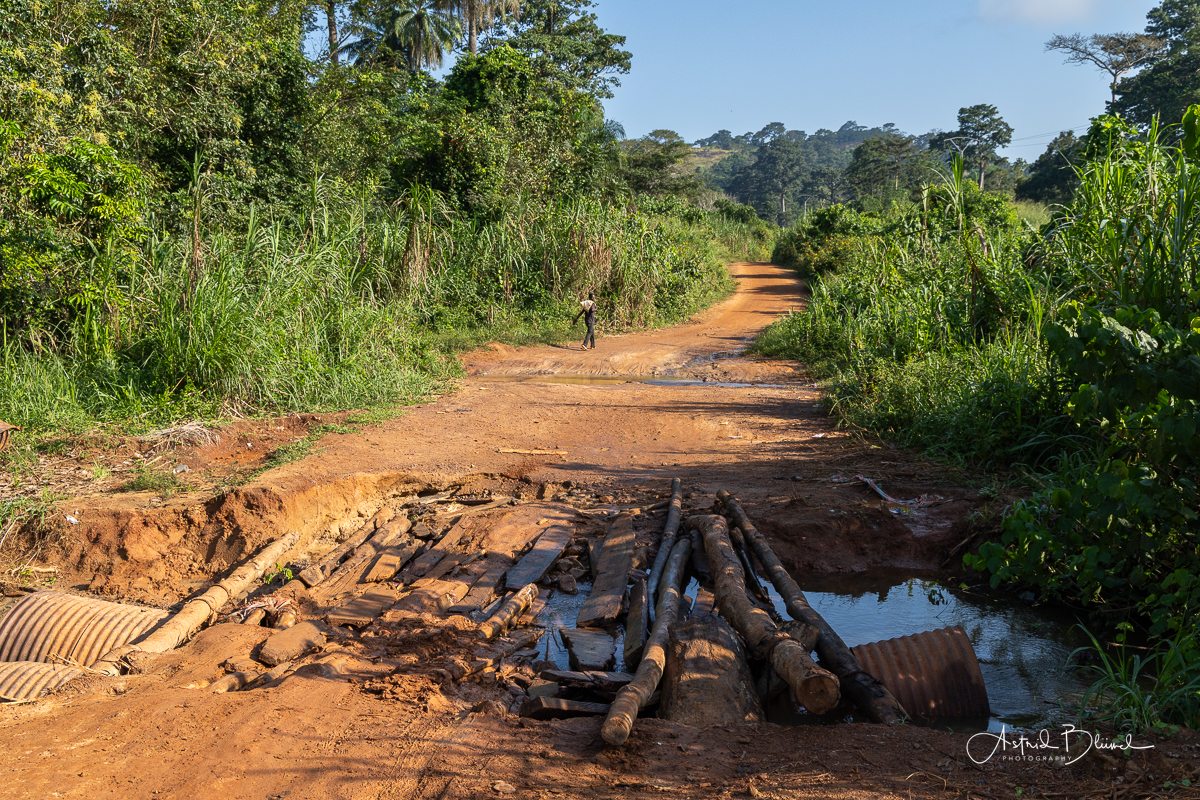
Most roads were really good, this one wasn’t !
We are led through the village, our chairs are already set up under a nice big tree. Sorry guys we need light not shade for the photos. So we move the lot over to a rather big open space between a few houses. The dance of the „jugglers“ is also known as the snake dance. It is a ritual dance where the participants, chosen at young age by the communities shaman, enter into communion with nature and sacred wild animals, especially the snake. They are chosen according to their spiritual gifts and similarity to the spirit of the snake. The four musicians show up and sit on a bench in the back, the dancers arrive, a man and 4 girls, 2 of them are about 10, one is around 5 or 6 and a little one, she can’t be older than 2. All girls are dressed up with colorful skirts and black&white painted faces and a cool headdress with brown or blondish hair and lots of beads and cowrie shells.
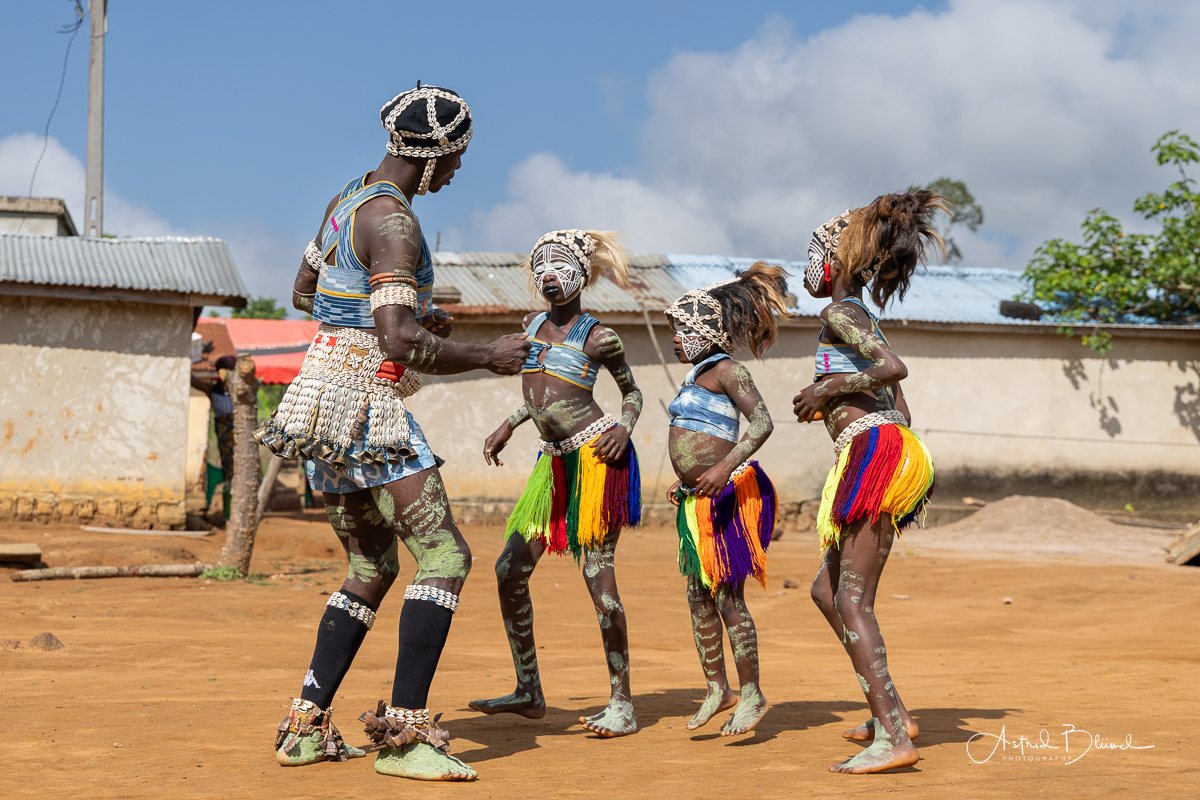
The snake girls are here
This is definitely one for the „do not try this at home“ section. The girls run to him, he catches them then throws them in the air during which they spin around their own axis. Hard enough as it is, but all this with a 30cm long knife in each of his hands. Imagine, they must absolutely totally trust this guy, to run and jump into his arms when 2 big knives are pointed at you when approaching, then get thrown in the air, spin, and come down hoping the knives are out of the way.
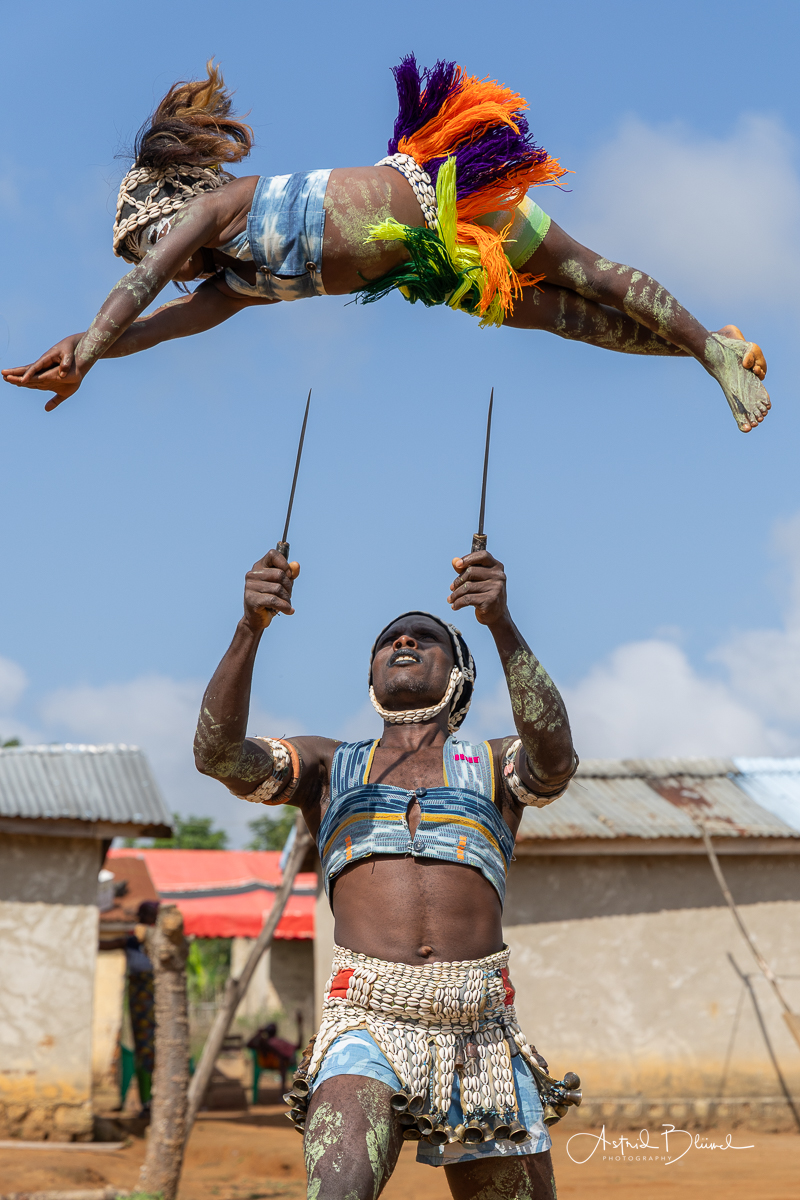
DO NOT TRY THIS AT HOME
They do all sorts of gymnastics, hang on his neck, just held by their feet, hang around his waist, don’t ask me how exactly. They stand on his shoulders, stand on his arms, get thrown about again, or swung around just held by their feet. Wow, what a show. After that a posing session with the girls, love it, the 6 year old is my absolute favorite, she is so very, very cute.
DAY 9: FISH, CACAO AND A MOSQUE
Easy day again, first stop after we cross the Sassandra River to go see the fishermen. They fish but there also seems to be a taxi service, more and more people arrive and get into the long canoe. A fisherman comes in and shows us his catch, and ashore a few women are busy frying fish. I spot Laz, (who is always lying somewhere whilst we shoot), under a roof, sitting in the shade and eating fish and attika, the cassava couscous, we decide it can’t get much fresher than this, right out of the river into the frying pan, so we also eat. Sort of an early lunch, it is delicious !
We get through about 7 police controls and finally reach the turn off to the cacao plantation in Douakoue, where our local guide is waiting. Another rather narrow road, Laz won’t like it, gets us into the bush. Funny, cacao pods grow on trees, but quite randomly. Sometimes just on one spot, in other spots there are five together, on the stem or on the branches, just anywhere on the tree. Yellow is ripe, green is unripe. The red ones are a different kind. Now to the village to see the opened pods and then the beans. In one hut there are a few big sacks, filled to the brim with the finished product, the dried cacao beans. They dry them in the sun, then pack them in huge bags which are then transported to be processed. I only learned whilst here, that Côte d’Ivoire is the worlds largest producer of cacao beans.
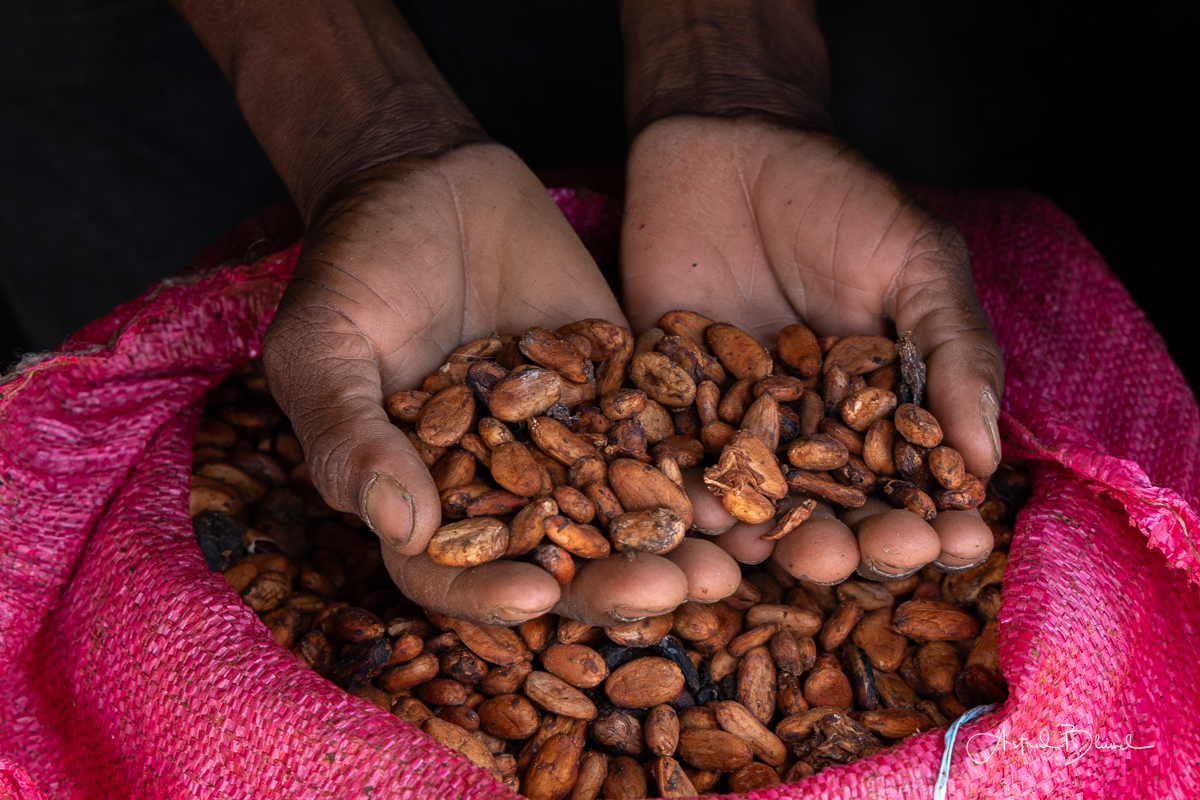
The dried cacao beans
Then to Yamoussoukro where we decide to go take a look at the mosque, see if it is any good. It is ! We walk around the outside, then see the inside. A nice man gets Chris and me a scarf to cover our heads, then we may enter. It is beautiful inside, high pillars, red carpets and the odd person doing his prayers. Not as big as the basilica but impressive in its own way.
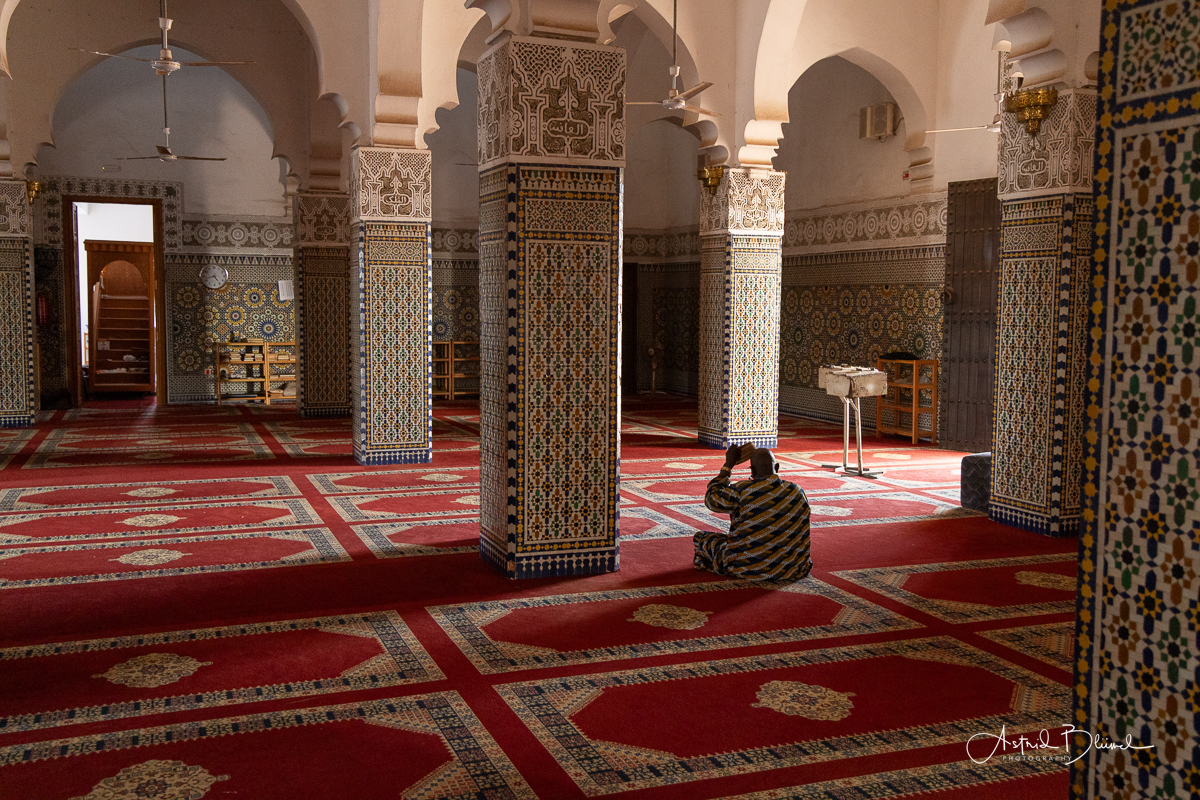
The mosque in Yamoussoukro
Day 10: RUBBER, RAIN AND THE BEACH
Just a driving day today, we drive straight on through Abidjan to Grand Bassam at the coast. Hardly a police control today and the roads, as we get closer to the capital Abidjan get better and better, a wide 4-lane highway, a few villages to pass, a few bus stops where they try to sell just about anything to the people on the bus, and that’s it. We stop at a rubber plantation. Hundreds of trees, in more or less neat rows, small black buckets hanging on each tree, which is a cool geometrical sight by itself. At the freshly cut trees white juice is slowly dripping down from the scratches in the bark into the little black bucket. To get these trees you plant a seed in a bucket of the white juice for about 6 weeks, then a small plant develops. Plant this little one and wait 7 years until the tree is fully grown to about 30m hight, and you can start harvesting the rubber.
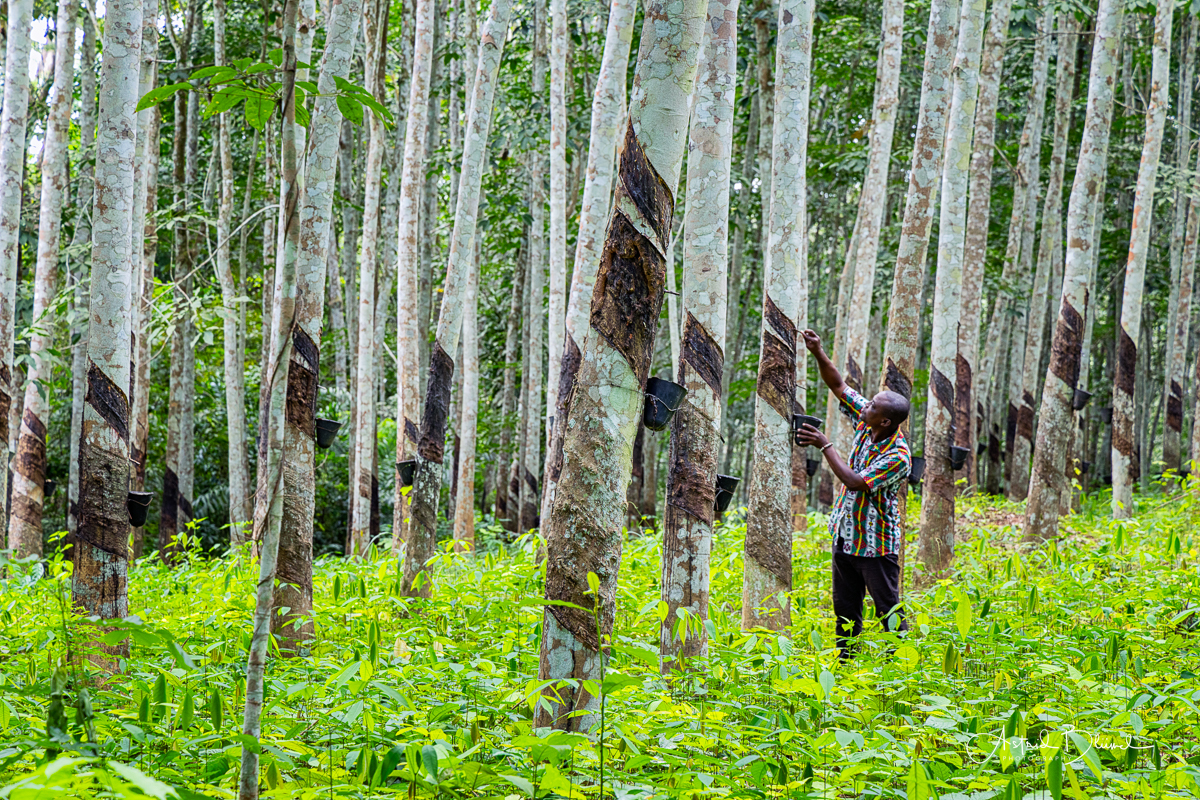
Visiting a rubber plantation
In Grand Bassam we visit the chocolate factory to see where all the cacao is going. It was just us and the lady in a 3m2 shop, where she explained all the chocolate making to us, and we got to try some. No chance to see the processing, probably secret recipe or so. It is dark chocolate, but I like it. Just as we are about to leave the heavens open once again, boy, it pours. Chris and I hop outside and from under a roof photograph people in the rain. At first everybody runs, but after 2min it is clear, when out there you are soaked anyway, so the pace slows and they even have time to smile at us. We get some cool shots.
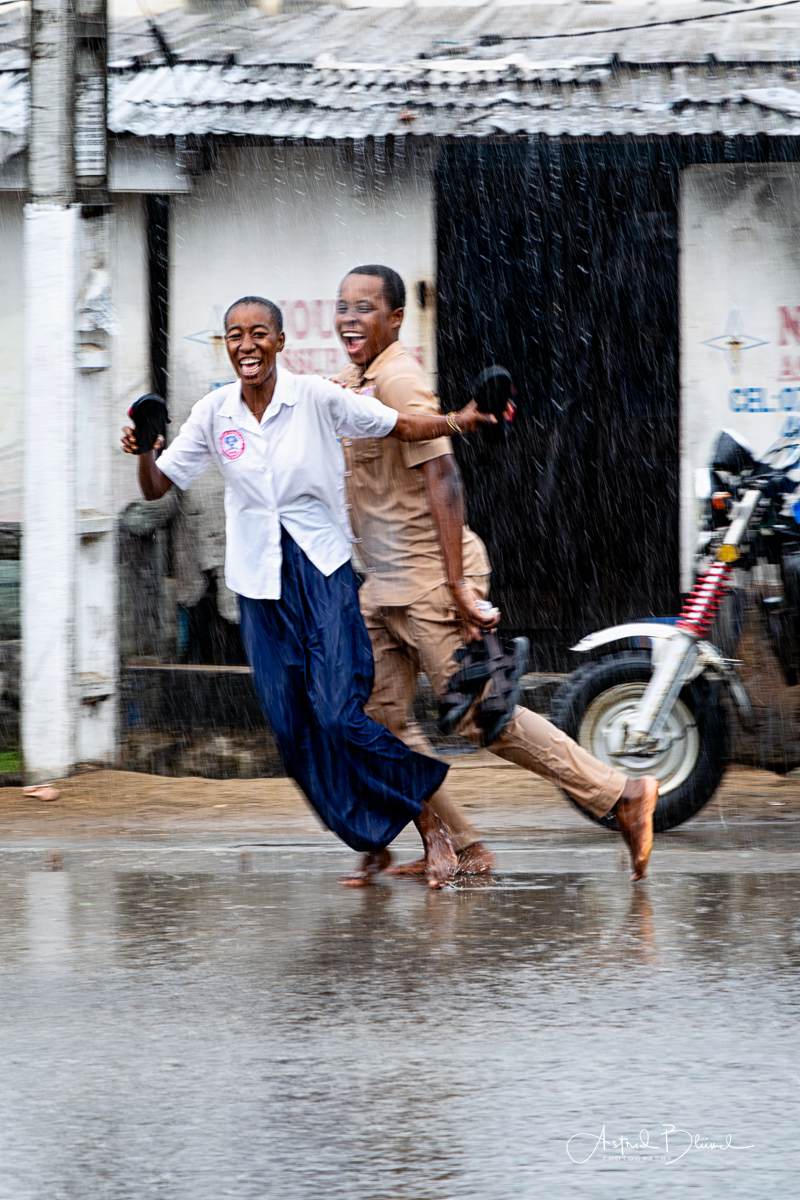
I’m singing in the rain
DAY 11: FISHING VILLAGE, CITY WALK AND MODELS
Rise and shine. After last nights rain and thunder the sky is now clear. We visit two fishing villages and see how they make nets, fix nets, clean the fish, and do other daily jobs. The second village has a huge beach, lots of palm trees, boats on the shore, guys fixing nets, women cooking, kids running about. We even get to see how they smoke the fish, the small ones nice rolled up, the bigger side by side, on the grill rack, on top of a big clay oven, which they fire from below.
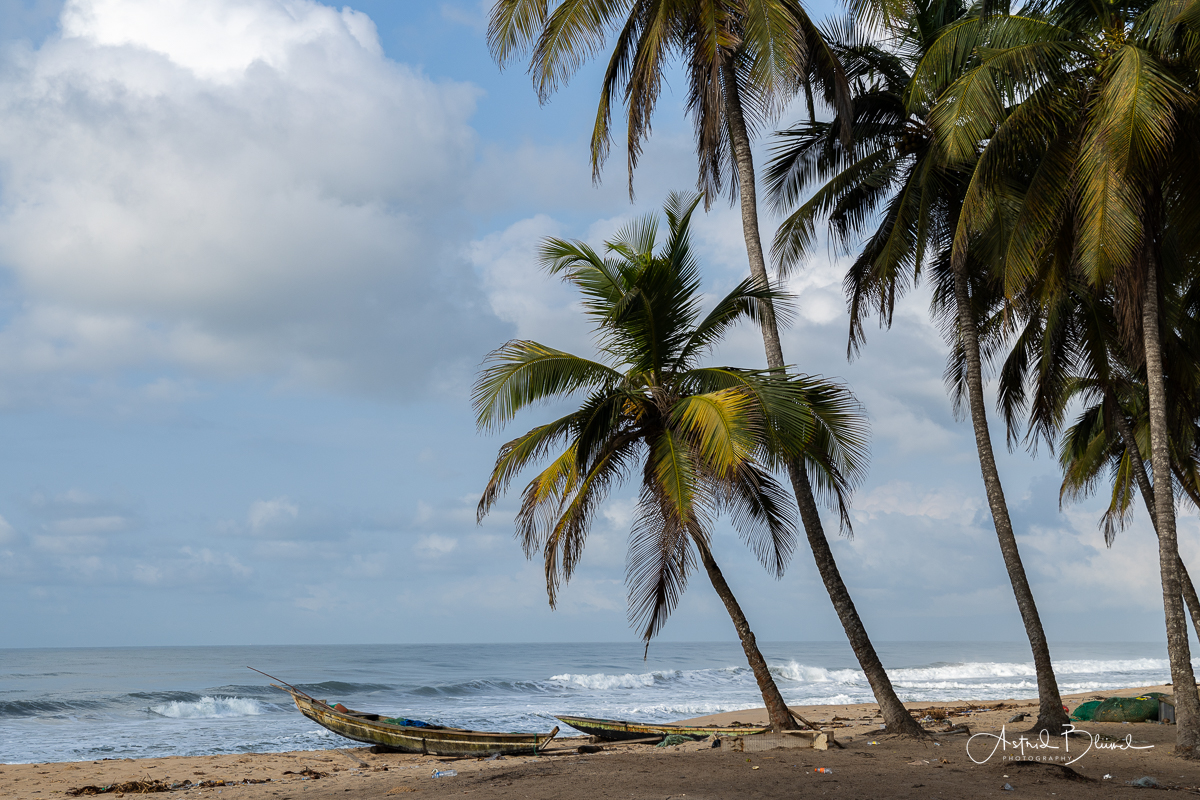
The nicest side of the fishing village
After brunch we start our walking tour of the town, in the heat of day as good tourists do. We stumble upon an art gallery with lots of wood carvings, see the atelier peinture where about ten painters exhibit their work. We find some funny murals and end up in Yah Live for drinks, attracted by the Bob Marley songs booming from its huge speakers. We do old crumbled down grand mansions, dating back to the 1890’s, and as we are photographing one very nicely overgrown one, almost like Angkor What, a guy runs inside and brings out his NIKON. Starts taking photos of us, we get to talk and he is a pro photographer doing a fashion shoot. A couple in the ultimate local traditional festive gowns plus jewelry, we are invited to join in, so Chris and I immediately say yes, the guys will just have to stay.
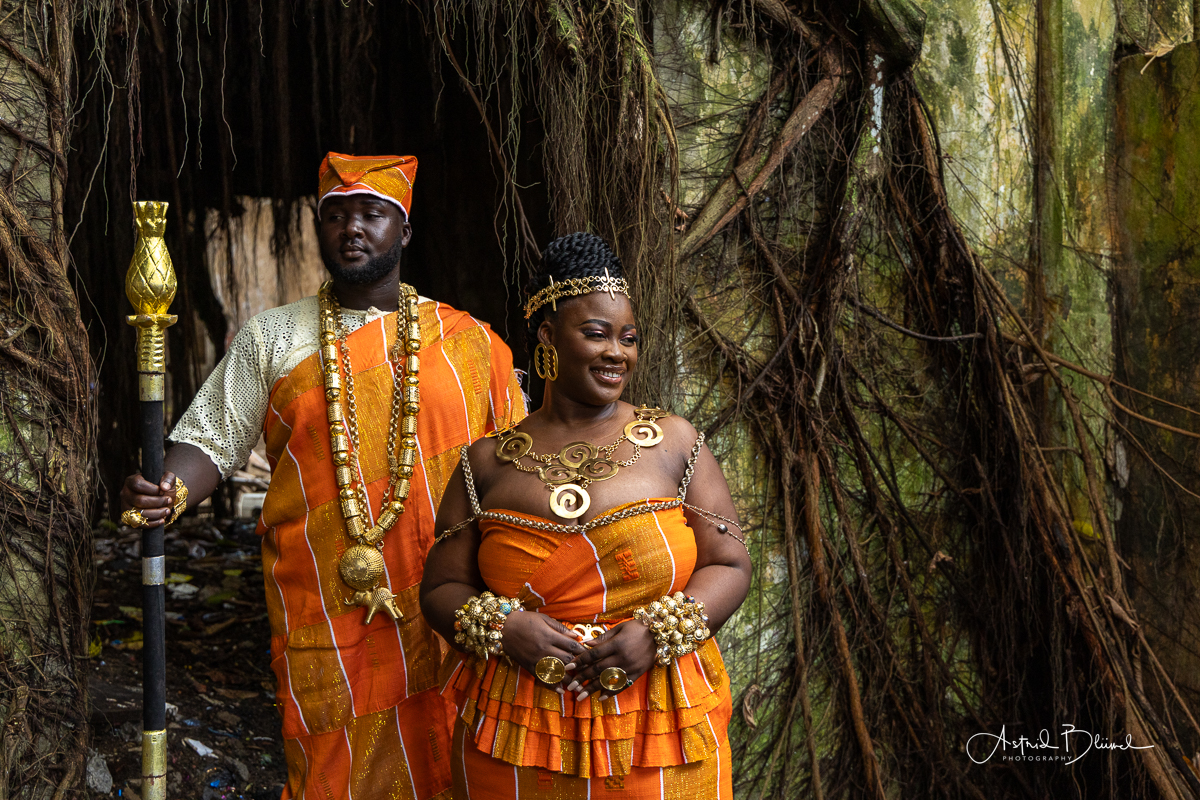
Joining in on a fabulous “pro” photo shoot
It is fabulous, the lady is dressed in orange and yellow and gold, there are two girls to dress her, a make-up artist, a seamstress and of course the photographer. The guy hanging round turns out to be the male model, he is being dressed like a king. My battery is flashing red, 6% left, shit, shit, shit. I didn’t think we would take this many photos on the walk, normally I have a spare battery in my pocket, of course now I don’t. But thank God, it lasts. That was a super-special bonus shoot.
After dinner at a lovely restaurant in town, we get a surprise. A cake with candles and two bottles of champagne for our wedding anniversary. A gift from Belem, the local tour chef. His kids drove over from Abidjan, not just to say goodbye to us, but also to deliver the cake and the champagne, such a lovely gesture, we really loved the surprise and the cake was great ! We walk home in the now very moderate lovely temperatures, taking along the rest of the cake for Yao, Felix and Laz, and the second bottle of bubbles, we’ll have that tomorrow when relaxing on the beach.
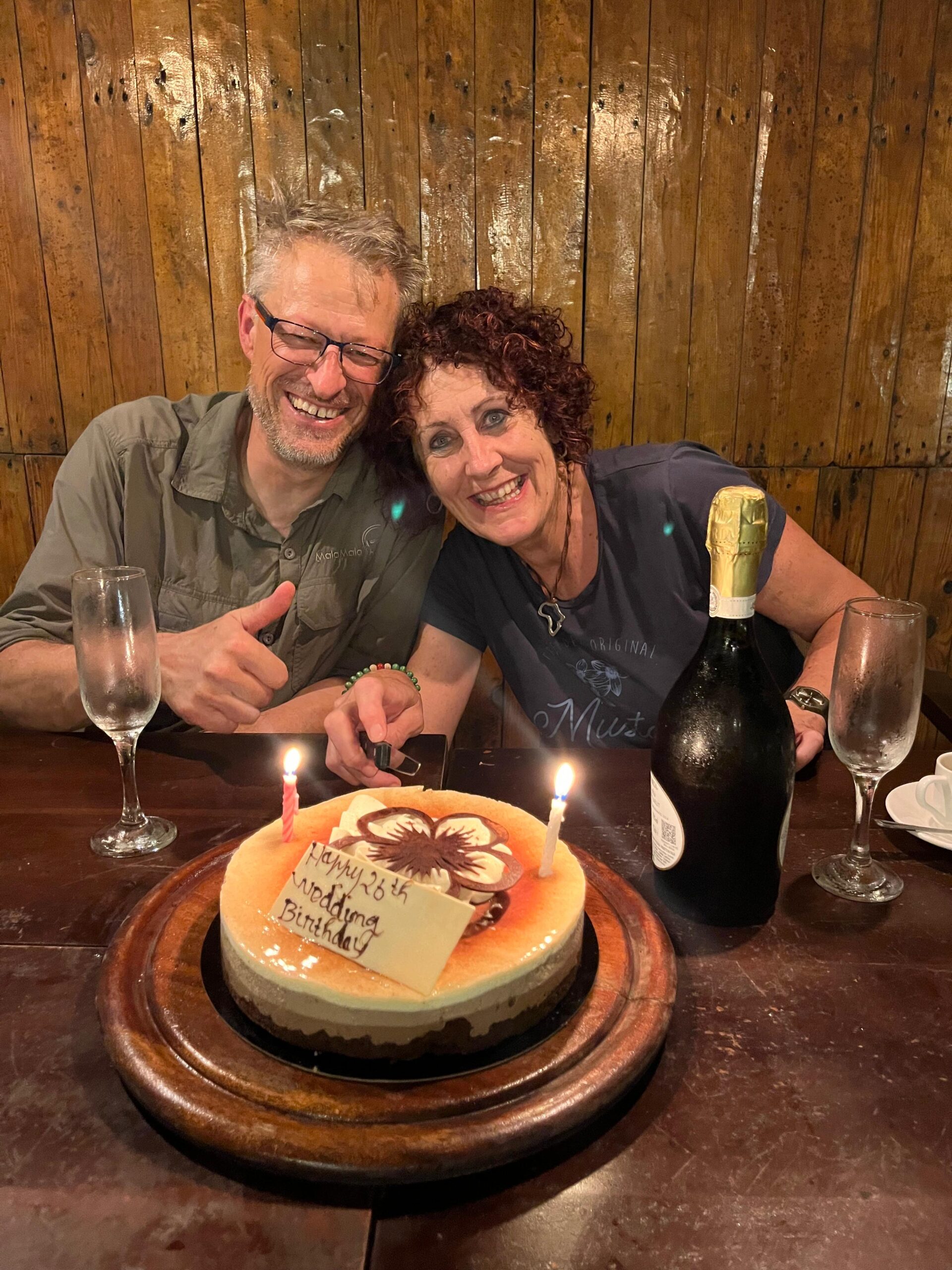
Us after 26 years of marriage, still going strong !
Thank you Côte d’Ivoire
This was such a very special, authentic, colorful, African experience.
I am absolutely in love with West Africa !
For our favorite photos: Go to gallery
copyright 2025: Astrid Bluemel for bluemelphoto.ch
recent comments